
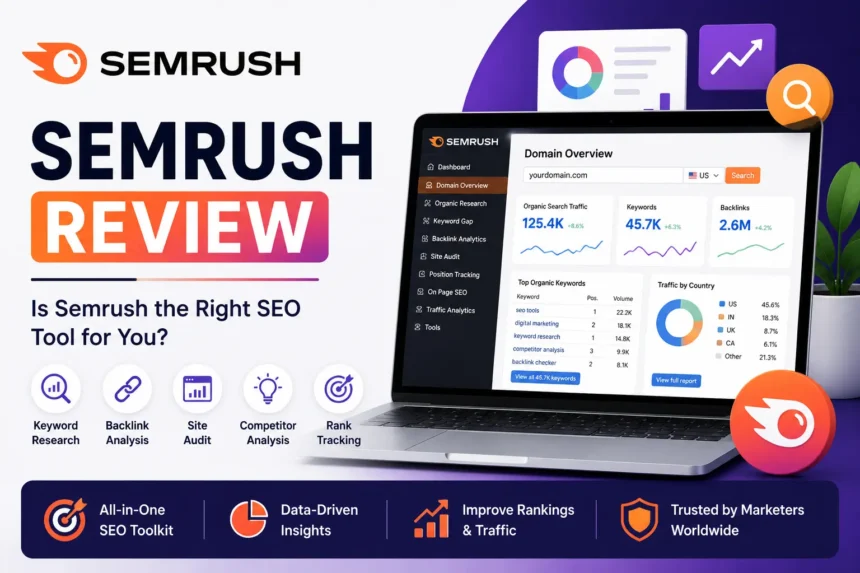
Semrush is one of those tools that almost every serious website owner eventually hears about.
Usually, it starts with keyword research.
You want to know what people are searching for, which keywords your competitors rank for, or how difficult it might be to compete for a particular search term.
Then you discover that Semrush can also analyse backlinks, audit your website, track rankings, research competitors, monitor brand mentions, help with content research, and provide tools for paid advertising.
At that point, Semrush stops looking like a simple keyword research tool.
And that is both its biggest strength and one of its biggest problems.
More Read

There is a lot inside Semrush.
For an SEO agency or a business with multiple websites, that can be extremely useful. For a small website owner, it can also mean paying for a collection of features that you rarely use.
So the real question is not:
“Is Semrush a good SEO tool?”
It clearly has a lot to offer.
The better question is:
“Will I actually use enough of Semrush to justify the subscription?”
That depends on how seriously you are working on SEO and what information you need.
Semrush Is Most Useful When You Stop Guessing and Start Looking at the Data
SEO can involve a lot of assumptions.
You may think a keyword has low competition because the search results look manageable.
You may assume a competitor receives most of its traffic from one topic.
Or you may believe a page is not ranking because the keyword is too competitive.
Sometimes those assumptions are correct.
Sometimes they are completely wrong.
Semrush gives you data that can help you investigate those questions instead of relying entirely on guesswork.
You can research keywords, analyse domains, look at organic visibility, study competitors, and identify potential content opportunities through Semrush’s official platform.
The important word here is investigate.
SEO tools do not tell you exactly what Google will do.
They provide estimates, databases, trends, and competitive information that can help you make better decisions.
That distinction matters because beginners sometimes treat keyword difficulty scores and traffic estimates as absolute facts.
They are useful indicators, not guarantees.
Keyword Research Is Still One of the Main Reasons People Use Semrush
This is probably where most website owners will spend the majority of their time.
You can start with a broad keyword and explore related search terms, questions, variations, and other ideas.
For example, suppose you are writing about web hosting.
You might start with a broad term such as “best web hosting.”
That alone is not enough.
You may discover more specific searches related to:
The goal is not simply to find keywords with the highest search volume.
A keyword with a huge volume may be difficult to compete for or may not attract the right audience.
Sometimes a more specific search can be more valuable because the person searching already knows what they want.
That is where Semrush can be particularly useful.
It helps you move beyond the obvious keyword ideas.
The Competitor Research Can Save a Lot of Time
One of the most practical things you can do with Semrush is study websites that are already succeeding in your niche.
Instead of opening hundreds of pages manually, you can investigate which keywords and pages appear to be generating organic visibility for a competitor.
This can help answer questions such as:
Which topics are already bringing traffic to similar websites?
Are competitors ranking for keywords I have completely ignored?
Which pages appear to be important for their SEO strategy?
Where are the gaps in my own content?
That does not mean you should copy another website.
In fact, blindly copying competitors is usually a bad content strategy.
The useful part is understanding the market.
You might discover that every competitor has written about a particular topic because users genuinely search for it.
Or you might notice that several websites are providing weak answers to an important query, creating an opportunity to produce something better.
That is much more useful than opening a keyword tool and randomly choosing terms with attractive numbers.
Keyword Difficulty Scores Are Helpful, but Don’t Let Them Decide Everything
This is something I would be careful about.
Semrush provides metrics designed to help estimate how difficult it may be to rank for particular keywords.
These scores can be useful when comparing opportunities.
But I would not automatically reject a keyword simply because the difficulty looks high.
Search results matter.
A keyword may have a high difficulty score, but the actual results could contain outdated pages, weak content, irrelevant results, or websites that are not particularly focused on the topic.
On the other hand, a keyword with a low difficulty score may still be difficult if the search intent is dominated by strong brands or Google features that reduce organic clicks.
So I would use the data to shortlist opportunities.
Then I would manually search the keyword and ask:
Can I realistically create something better or more useful than what already ranks?
That final check is something no SEO tool should replace.
The Site Audit Can Help You Find Problems You Didn’t Know Existed
Another major part of Semrush is its site auditing functionality.
A website can have technical problems without the owner noticing them.
Broken links, missing tags, crawlability issues, duplicate content signals, slow pages, redirect problems, and other technical issues can build up over time.
A site audit can help identify potential problems and organise them into areas that need attention.
But there is one important warning.
Do not panic when an SEO tool shows dozens or hundreds of warnings.
Not every warning has the same importance.
Some issues can genuinely affect how search engines crawl or understand your website.
Others may be recommendations that are technically useful but unlikely to transform your rankings.
I would prioritise issues based on impact rather than trying to reach a perfect score.
A website does not need every SEO tool indicator to be 100% green.
It needs to be technically accessible, useful to users, and free from significant problems.
Backlink Research Is Useful, but It Shouldn’t Become an Obsession
Semrush can also help you research backlinks.
You can look at domains linking to your website and compare your backlink profile with competitors.
This can be useful for understanding how other websites have earned links and identifying potential outreach opportunities.
But backlink metrics should be treated carefully.
A website with a higher authority score is not automatically better than one with a lower score.
Google does not use every third-party metric displayed inside SEO tools.
What matters more is the quality and relevance of the linking website and whether the link exists naturally for a useful reason.
I would use Semrush for backlink research and competitive analysis.
I would not build an entire SEO strategy around chasing a particular third-party authority number.
Position Tracking Is More Useful Than Checking Google Manually Every Day
Most website owners have done this.
You publish an article.
Then you search Google for the target keyword.
Then you search again tomorrow.
And again the next day.
There are several problems with that approach.
Search results can be personalised. Rankings can vary by location and device. And manually checking dozens or hundreds of keywords quickly becomes impossible.
Position tracking tools provide a more organised way to monitor selected keywords over time.
The useful part is not seeing whether you moved from position 12 to position 11 on a particular day.
The useful part is identifying larger patterns.
Are your new pages gradually gaining visibility?
Did a website update cause several important keywords to decline?
Are competitors consistently improving for a particular topic?
Those trends can help you decide where to investigate further.
Semrush Can Also Be Useful for Content Planning
Keyword research becomes much more useful when you connect individual keywords to a broader content strategy.
Instead of publishing unrelated articles every week, you can use research data to identify topic clusters.
For example, a website focused on ecommerce might build content around:
Within each topic, there may be comparison articles, tutorials, alternatives, pricing guides, and product reviews.
This type of approach can help create a more organised website.
The important thing is that the content should still exist because it is useful for readers.
Creating 100 articles simply because a keyword tool found 100 low-volume keywords is not necessarily a good strategy.
Semrush Is Not Cheap, and That Is the Biggest Reason to Think Before Subscribing
This is probably the biggest drawback for individual bloggers and small website owners.
Semrush is a professional-level platform, and the pricing can be difficult to justify if you only research a few keywords each month.
That does not mean you need to avoid it completely.
One practical approach is to use a subscription intensively.
Research your main competitors.
Build a large keyword list.
Plan content for several months.
Run a full site audit.
Export or organise the information you need.
Then decide whether you actually need ongoing access.
If you actively work on SEO every week, a continuing subscription may make sense.
If you only open the tool twice a month, you should ask whether you are getting enough value from it.
Before subscribing, always check the current plans and feature limits on Semrush’s pricing page, as prices and allowances can change.
Semrush vs Ahrefs: Which One Is Better?
This is not as simple as choosing a winner.
Both Semrush and Ahrefs are widely used SEO platforms, and both offer keyword research, competitor analysis, backlink research, and other SEO tools.
The better choice depends on how you work.
Some people prefer one interface. Others prefer particular databases, reports, or workflows.
I would not choose based only on online arguments about which tool has the “most accurate” traffic data.
No third-party SEO tool has access to every website’s actual Google Analytics data.
Traffic estimates are estimates.
The more useful comparison is practical:
Which tool helps you find better content opportunities?
Which interface do you understand more easily?
Which reports do you actually use?
Which subscription fits your budget?
If possible, test the available tools before committing to a long-term subscription.
Semrush Can Be Overwhelming for Beginners
This is a genuine disadvantage.
When you first open Semrush, there are many reports, menus, metrics, and tools.
It can be tempting to click everywhere without knowing what you are looking for.
I would not try to learn everything.
For a content-focused website, I would start with four areas:
- Keyword research.
- Competitor research.
- Site audit.
- Position tracking.
Those four alone can provide enough information for most basic SEO work.
Once you become comfortable, you can explore additional features that match your workflow.
Trying to master every Semrush tool immediately is unnecessary.
Who Should Consider Semrush?
Semrush makes the most sense for people who actively make SEO decisions based on research.
I would seriously consider it if you are:
It may be harder to justify if you only have a small website and rarely perform SEO research.
There are cheaper and free tools that may cover the basics.
The key question is whether Semrush will save enough time or help you make better decisions to justify the subscription.
My Honest Take: Semrush Is Powerful, but the Value Depends on How Often You Use It
Semrush is not the kind of tool I would recommend subscribing to simply because every SEO professional mentions it.
It is powerful, but power is not the same as value.
If you actively publish content, analyse competitors, monitor rankings, and work on SEO every week, Semrush can become part of your regular workflow.
If you only want to check your domain authority occasionally, it is probably more than you need.
The biggest benefit is not any single metric.
It is having multiple sources of SEO research in one place.
You can move from keyword research to competitor analysis, then check your own site’s technical issues and monitor rankings without constantly switching between unrelated tools.
That convenience can save a lot of time.
So, Is Semrush Worth It?
Yes, for serious website owners, SEO professionals, agencies, and affiliate marketers who regularly need keyword, competitor, technical, and ranking data.
Maybe not, for someone who only performs basic SEO research once in a while.
My advice would be to start with a specific task.
Research competitors.
Build your content plan.
Audit your website.
Track your most important keywords.
If Semrush becomes something you open regularly and use to make real decisions, the subscription can make sense.
If you are only checking random metrics because they are interesting, you probably do not need it.
You can explore the platform and its current tools through Semrush’s official website.
Frequently Asked Questions
Is Semrush good for beginners?
Yes, but it can feel overwhelming initially because the platform includes many different tools. Beginners can start with keyword research, competitor analysis, site audits, and position tracking before exploring more advanced features.
Is Semrush accurate?
Semrush provides useful estimates and SEO data, but metrics such as traffic estimates and keyword difficulty should not be treated as exact facts. They are best used for comparison, research, and identifying trends.
Is Semrush worth paying for?
It can be worth paying for if you regularly perform keyword research, competitor analysis, rank tracking, technical SEO work, or backlink research. For occasional use, the subscription may be difficult to justify.
Can Semrush help me find keywords?
Yes. Semrush provides keyword research tools that can help you discover related keywords, analyse search demand, study competitors, and identify potential content opportunities.
Is Semrush better than Ahrefs?
Neither tool is automatically better for every user. Both offer strong SEO research capabilities. The best choice depends on the specific features, workflow, data, and pricing that fit your needs.