

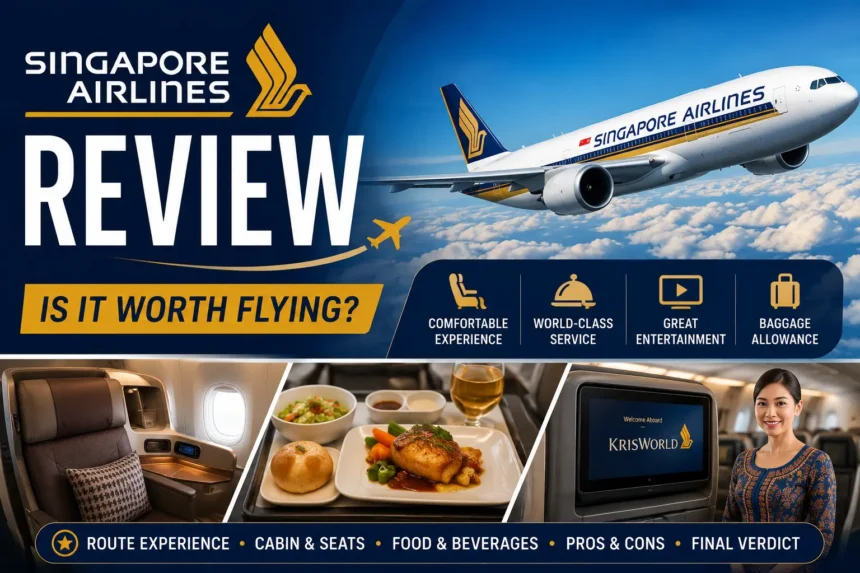
There are airlines you choose because the ticket is cheap, airlines you choose because the schedule is convenient, and then there are airlines you choose because the journey itself is supposed to be part of the experience.
Singapore Airlines falls firmly into the third category.
For years, the airline has built its reputation around polished cabin service, well-presented meals, comfortable long-haul cabins and a level of consistency that has made it one of the most respected names in international aviation.
But reputation can create high expectations.
A premium airline can look impressive in advertisements and still disappoint when the seat isn’t right, the connection is inconvenient, the Wi-Fi struggles or the fare costs considerably more than a competitor.
So, what is Singapore Airlines actually like in 2026?
More Read

The answer depends quite a bit on which cabin you’re flying, which aircraft operates your route and how much you’re paying for the ticket.
Economy Class is generally a comfortable long-haul proposition, while Business Class offers a much more substantial upgrade in space and privacy. At the top end, Singapore Airlines’ Suites remain one of aviation’s most recognizable luxury products.
At the same time, not every aircraft has the same seat, and the airline is currently in the middle of a broader product-refresh program.
We’ve looked at the booking experience, cabins, food, entertainment, Wi-Fi, service, baggage, lounges and KrisFlyer to find out whether Singapore Airlines still deserves its premium reputation in 2026.
What Makes Singapore Airlines Different?
Singapore Airlines has spent decades building a very particular identity.
The airline doesn’t try to compete purely on price. Instead, it sells a combination of:
Service + comfort + food + technology + consistency.
That approach is noticeable from the moment you begin looking at a booking.
The website and app are designed around managing an entire journey rather than simply purchasing a ticket. Once booked, passengers can manage seats, meals, baggage and other parts of the trip.
But the real test starts at the airport.
Singapore Changi Airport is the airline’s home hub, and connections through Singapore are a major part of its global network.
For travelers flying between Europe, North America, Australia and Asia, that can make Singapore Airlines a particularly useful option even when Singapore isn’t the final destination.
Booking a Singapore Airlines Flight
The booking experience is relatively straightforward.
You can search by:
After selecting a flight, the important part is understanding exactly what your fare includes.
This is where travelers shouldn’t rush.
Check:
The cheapest fare isn’t necessarily the best value if you later need to change your itinerary.
For long-haul travel, I’d also pay close attention to the aircraft.
Singapore Airlines operates several aircraft types and configurations, meaning the Business Class seat—or even the Economy seat—can differ depending on the flight.
Economy Class: Surprisingly Good for a Long Flight
Economy is where Singapore Airlines has an interesting advantage.
You don’t need to spend thousands of dollars on Business Class to notice that the airline takes the basic passenger experience seriously.
On many international aircraft, Economy seats provide around 32 inches of pitch, with seat width varying by aircraft. Singapore Airlines also equips many long-haul Economy cabins with personal entertainment screens and USB connectivity.
The seat isn’t enormous.
It is still Economy Class.
But on a 10-, 12- or 15-hour flight, the difference between a reasonably designed Economy seat and a cramped one becomes very noticeable.
The headrest and seat design also help make sleeping somewhat easier, although your own height and the particular aircraft configuration will ultimately determine how comfortable you feel.
The Reality
If you’re expecting Business-Class comfort, you’ll be disappointed.
If you’re comparing Singapore Airlines Economy with a typical long-haul Economy cabin, however, it is a very competitive product.
Economy verdict: One of the better reasons to choose Singapore Airlines even without upgrading.
Premium Economy: A More Noticeable Upgrade
Premium Economy sits in an interesting position.
It’s designed for passengers who want more personal space without paying Business Class prices.
Singapore Airlines’ Premium Economy seats generally provide around 38 inches of pitch and up to approximately 20 inches of width, depending on aircraft.
That’s a meaningful improvement over standard Economy.
You also get additional recline and leg support, along with other cabin-specific benefits.
But there’s an important question:
How much more does the ticket cost?
If Premium Economy is only moderately more expensive than Economy, it can make a lot of sense on a long overnight flight.
If the fare difference starts approaching Business Class territory, the calculation becomes much less attractive.
That’s one reason Premium Economy isn’t necessarily the automatic sweet spot of the Singapore Airlines lineup.
Business Class Is Where Things Get Serious
Singapore Airlines Business Class is designed primarily around long-haul comfort.
On widebody aircraft, the airline has moved toward a 1-2-1 configuration, giving passengers direct aisle access. Singapore Airlines says its ongoing product upgrades are also intended to deliver full-flat Business Class beds across the network as older aircraft are retired.
That’s important because Business Class isn’t simply about getting a wider chair.
On a long overnight flight, the ability to turn the seat into a proper flat bed can completely change the experience.
You can work, eat, watch a movie and then actually sleep.
Some Singapore Airlines Business Class seats are particularly wide, although individual designs vary by aircraft.
And this is where checking the aircraft before booking becomes essential.
Two flights sold as Singapore Airlines Business Class can offer noticeably different seating experiences.
What Is Business Class Actually Like?
The cabin feels more private than Economy, the service is more personalized and meals are served with considerably more attention to presentation.
The biggest advantage, however, is the space.
You aren’t fighting for elbow room.
You aren’t climbing over another passenger to reach the aisle on a 1-2-1 widebody configuration.
And on overnight flights, the flat-bed capability becomes the main reason to pay the premium.
A recent independent Business Class review praised Singapore Airlines’ cabin presentation and crew service, while also noting that the seat itself has some quirks depending on the aircraft.
That’s a useful reminder that Singapore Airlines Business Class isn’t one universal product.
Check the seat map before you spend the money.
Singapore Airlines Suites and First Class
At the top of the range is Singapore Airlines’ Suites product.
Available on selected Airbus A380 aircraft, Suites are designed to provide a level of privacy that goes far beyond a conventional Business Class seat.
You get a private personal space with a fully flat bed, and selected configurations offer an unusually large amount of room.
It’s the kind of product designed for travelers who don’t simply want to arrive at their destination—they want the flight to be an experience in itself.
Of course, there’s a problem.
The price.
Suites can be extremely expensive when purchased with cash.
For most travelers, this is not a rational way to save money on transportation.
It’s a luxury purchase.
For frequent-flyer enthusiasts using miles, however, Singapore Airlines Suites can become a much more interesting proposition.
Food on Singapore Airlines
Food is one of the areas where Singapore Airlines has traditionally put considerable effort.
Meals are served across international cabins, with different menus depending on the route and cabin.
Passengers can generally expect a choice of main courses on longer services, along with beverages and snacks.
And then there’s Book the Cook.
On eligible flights and premium cabins, passengers can pre-select from a larger menu before departure.
This is particularly useful if you have a favorite dish in mind or simply want more control over what you’re eating during a long flight.
Singapore Airlines has also been refreshing its food and beverage offering as part of its wider product upgrades.
What About the Singapore Sling?
Yes, the famous Singapore Sling remains part of the airline’s onboard identity.
It can be ordered on many services where alcoholic beverages are available.
It’s a small detail, but it’s also part of what makes the airline experience feel connected to Singapore rather than like a generic international carrier.
In-Flight Entertainment
Singapore Airlines’ entertainment platform, KrisWorld, is another strong point.
Long-haul passengers get seatback entertainment on many aircraft, with movies, television programs, music and other content.
This matters more than it sounds.
On a 13-hour flight, entertainment isn’t a luxury.
It’s part of the experience.
Singapore Airlines is also preparing a new generation of KrisWorld as part of its upcoming cabin refresh. The airline says the next-generation product will include an all-new entertainment experience alongside new seats, dining and amenities.
That means the onboard experience should continue changing over the next few years.
Singapore Airlines Wi-Fi
This is one area where Singapore Airlines has made a particularly significant move.
KrisFlyer members can access free and unlimited Wi-Fi across the airline’s network, provided their membership details are linked to the booking according to the applicable requirements.
That’s a meaningful benefit.
You don’t necessarily have to be sitting in Business Class to get it.
Economy passengers can also benefit.
The catch is that onboard connectivity is still not the same as having a high-speed broadband connection on the ground.
Singapore Airlines says the service is designed for things such as:
High-bandwidth activities such as video streaming and video calls may not work reliably.
So don’t board expecting to stream a 4K movie or run a full workday through the aircraft Wi-Fi.
Cabin Crew and Service
This is arguably Singapore Airlines’ biggest selling point.
The airline has built an enormous part of its global reputation around cabin crew service.
And the emphasis isn’t simply on being polite.
It’s about consistency.
Meals arrive at the expected time.
Cabins are generally well presented.
Crew members are attentive without constantly interrupting passengers.
In premium cabins, the service becomes more personalized.
Independent reviews continue to highlight the quality of Singapore Airlines’ cabin crew, although individual experiences can naturally vary between flights and crews.
That last point is important.
No airline can deliver an identical experience on every flight.
But Singapore Airlines’ service culture remains one of its strongest competitive advantages.
Baggage Allowance
Baggage allowances depend on your:
Route + cabin + fare + frequent-flyer status.
This is important because there isn’t one universal Singapore Airlines baggage allowance.
For many international routes, Economy, Premium Economy and Business have different checked-baggage allowances, while some routes use different baggage concepts.
For example, Singapore Airlines currently explains that baggage rules can differ depending on the itinerary, particularly between routes involving the Americas and other regions.
Your exact allowance will be displayed on your ticket and booking confirmation.
Don’t rely on a generic number you found in an old review.
Check the baggage allowance attached to your actual itinerary.
Singapore Airlines Lounges
For passengers connecting through Singapore, the airport experience is a major part of the airline journey.
Singapore Airlines operates SilverKris Lounges for eligible premium-cabin and frequent-flyer passengers.
The airline opened its new First Class SilverKris Lounge at Changi Terminal 2 in late 2025 and is continuing a broader lounge-refresh program. Its investor materials also list a new Melbourne SilverKris Lounge targeted for completion in Q3 2026.
Eligible Business Class, First Class and Suites passengers can access applicable lounges, while qualifying KrisFlyer and Star Alliance elite members may also have lounge access depending on their itinerary and status.
Economy and Premium Economy passengers generally don’t receive lounge access simply because they’re flying Singapore Airlines.
KrisFlyer: Singapore Airlines’ Frequent-Flyer Program
Singapore Airlines’ loyalty program is called KrisFlyer.
It’s particularly important if you fly Singapore Airlines regularly or collect transferable credit-card points.
KrisFlyer can be used to earn miles from eligible flights and partner activity and redeem them for award travel.
The program becomes more valuable if you’re willing to understand award availability, fare classes and redemption rules.
For casual travelers, however, you don’t need to become a mileage expert to benefit.
Simply attaching your KrisFlyer number to the booking can provide useful benefits, including free Wi-Fi for eligible members.
Is Singapore Airlines Good for Long-Haul Travel?
This is where the airline makes the most sense.
If you’re flying:
Europe → Singapore → Australia
or
North America → Singapore → Southeast Asia
or another long international itinerary, the quality of the aircraft, food, service and entertainment becomes much more important.
On a two-hour flight, a mediocre seat isn’t a disaster.
On a 13-hour flight, it can dominate your entire travel experience.
Singapore Airlines is particularly strong for these longer journeys.
What About Connecting Through Singapore?
Singapore Changi is one of the airline’s biggest advantages.
The hub is designed around international connections, and Singapore Airlines has an extensive network through the city.
For travelers who don’t live in Singapore, this means you can use the airline to reach destinations across Southeast Asia, Australia, New Zealand and other parts of Asia with a connection in Singapore.
The downside is obvious:
Sometimes the Singapore routing isn’t the shortest option.
If you’re flying from Europe to Australia, for example, Singapore may add distance compared with another carrier’s routing.
So the decision becomes a balance between:
Travel time vs. airline experience.
Singapore Airlines vs Emirates
Emirates is one of Singapore Airlines’ most obvious competitors.
Both are premium-focused Gulf/Asian international carriers with extensive long-haul networks.
Emirates generally has a stronger reputation for its enormous entertainment selection and A380 product.
Singapore Airlines’ strengths are more closely associated with service consistency, food and its polished cabin experience.
For Business Class, the best choice can depend heavily on aircraft.
Don’t simply compare the airline names.
Compare the actual flight and seat.
Singapore Airlines vs Qatar Airways
Qatar Airways is another serious competitor, particularly in Business Class.
Qatar’s Qsuite has become one of the industry’s best-known premium products, offering private suites and, on selected configurations, doors and flexible seating arrangements.
Singapore Airlines counters with strong service, excellent food and its own high-end Business Class and Suites products.
If both airlines are available, I’d compare:
Price + aircraft + seat + connection time + lounge + frequent-flyer value.
Not just the brand.
What I Like About Singapore Airlines
The Service
The cabin crew remain one of the airline’s biggest strengths.
Economy Is Actually Good
You don’t have to spend thousands on Business Class to have a respectable long-haul experience.
Excellent Long-Haul Product
The combination of food, entertainment, comfort and service works particularly well on long journeys.
Free Wi-Fi for KrisFlyer Members
This is a meaningful advantage, especially for Economy passengers.
Strong Premium Cabins
Business Class and Suites can provide a genuinely luxurious experience.
Changi Hub
Singapore is a highly effective connecting point for Asia-Pacific travel.
What Could Be Better?
Ticket Prices
Singapore Airlines can be expensive.
If the premium over a competitor is enormous, the value proposition becomes less convincing.
Aircraft Differences
The Singapore Airlines experience isn’t identical across every aircraft.
Always check the aircraft and seat configuration.
Wi-Fi Isn’t Perfect
Free doesn’t necessarily mean fast.
The service is good for basic connectivity but isn’t designed to replace a home broadband connection.
KrisFlyer Can Take Work
The program is useful, but maximizing miles and awards requires more effort than simply joining a basic airline loyalty scheme.
Premium Economy Value Depends on the Fare
If the price gap becomes too large, Business Class may be the more interesting upgrade.
Who Should Fly Singapore Airlines?
Singapore Airlines makes the most sense for travelers who prioritize the experience of getting there.
It’s especially attractive for:
Long-haul travelers who want a comfortable journey.
Families who value dependable service and entertainment.
Business travelers who need to arrive rested.
Frequent flyers who can benefit from KrisFlyer.
Luxury travelers interested in premium cabins and Suites.
Travelers connecting through Singapore to Southeast Asia or Australia.
It may be less compelling for travelers whose only priority is finding the cheapest possible ticket.
Is Singapore Airlines Worth the Extra Money?
This is the question that matters most.
Suppose another airline costs $700 and Singapore Airlines costs $1,000.
Is Singapore Airlines worth $300 more?
There is no universal answer.
If the cheaper airline offers a comparable aircraft, similar schedule and a comfortable nonstop route, I’d probably take the cheaper ticket.
But if Singapore Airlines offers a significantly better schedule, a high-quality long-haul aircraft, better connection timing and a noticeably stronger cabin experience, the premium can make sense.
The longer the flight, the more valuable those differences become.
For a 90-minute journey, I wouldn’t pay a huge premium.
For a 13-hour overnight flight, I might.
Singapore Airlines Review: Final Verdict
Singapore Airlines has a reputation that could easily become a burden.
When an airline is constantly described as one of the world’s best, passengers expect perfection.
And Singapore Airlines isn’t perfect.
Aircraft configurations vary. Wi-Fi can be inconsistent. Premium fares can be expensive, and the best seat isn’t available on every aircraft.
But when everything lines up—the right aircraft, a good fare, a convenient connection and a well-operated flight—the airline can deliver an excellent international travel experience.
Its strongest qualities aren’t one flashy feature.
They’re the details.
The cabin is generally well presented.
The crew are professional.
The food is taken seriously.
The entertainment is strong.
Economy is comfortable enough for long-haul travel.
Business Class provides a substantial upgrade.
And Suites remain an aviation bucket-list experience.
The airline is also investing in the future, with new seats, refreshed dining, next-generation KrisWorld entertainment and upgraded lounges planned or already being introduced.
Overall Rating: 4.7/5
Would we fly Singapore Airlines? Absolutely.
But we would still compare the fare against Qatar Airways, Emirates, Cathay Pacific, Qantas, British Airways, Lufthansa and other relevant carriers before booking.
The airline is worth paying a premium for when the premium is reasonable.
That’s the key.
Frequently Asked Questions
Is Singapore Airlines a good airline?
Yes. Singapore Airlines remains one of the strongest international carriers, particularly for long-haul travel. Its service, food, cabin quality and entertainment are among its biggest strengths.
Is Singapore Airlines good in Economy Class?
Yes. Economy Class offers a comfortable long-haul experience with meals, entertainment and generally well-designed seating. Exact comfort varies by aircraft.
Does Singapore Airlines have Wi-Fi?
Yes. Wi-Fi is available on most aircraft, and KrisFlyer members can receive free and unlimited Wi-Fi when the applicable requirements are met.
Is Singapore Airlines Wi-Fi free?
KrisFlyer members can access free and unlimited Wi-Fi across the airline’s network, subject to the applicable terms and having the membership details linked to the booking.
Does Singapore Airlines serve free food?
Yes. Meals and beverages are included on applicable international services, with the exact offering depending on route and cabin.
What is Book the Cook on Singapore Airlines?
Book the Cook allows eligible passengers, particularly in premium cabins on selected routes, to pre-select from an expanded menu before their flight.
Is Singapore Airlines Business Class worth it?
For long overnight flights, it can be. The biggest advantages are additional space, direct aisle access on many widebody aircraft and a fully flat bed on applicable aircraft.
Does Singapore Airlines have First Class?
Yes. First Class is available on selected routes and aircraft. Singapore Airlines also operates its premium Suites product on selected Airbus A380 services.
What is KrisFlyer?
KrisFlyer is Singapore Airlines’ frequent-flyer program. Members can earn miles through eligible travel and partners and redeem them for qualifying rewards.
Does Singapore Airlines have good entertainment?
Yes. Its KrisWorld entertainment system provides a large selection of movies, television programs, music and other content. The airline is also developing a next-generation KrisWorld experience.
Is Singapore Airlines better than Emirates?
It depends on the route and aircraft. Singapore Airlines is particularly strong in service and overall consistency, while Emirates has its own strengths in entertainment and premium-cabin products. Compare the specific flight rather than choosing solely by airline.
Is Singapore Airlines better than Qatar Airways?
Both are excellent international carriers. Qatar Airways can have an advantage with Qsuite on eligible flights, while Singapore Airlines offers a strong combination of service, food and premium cabins. Aircraft and fare should determine the final choice.
Is Singapore Airlines worth the price?
If the fare premium is reasonable and you’re flying long-haul, Singapore Airlines can be worth paying more for. If another carrier is substantially cheaper with a similar schedule and aircraft, the cheaper option may offer better value.