

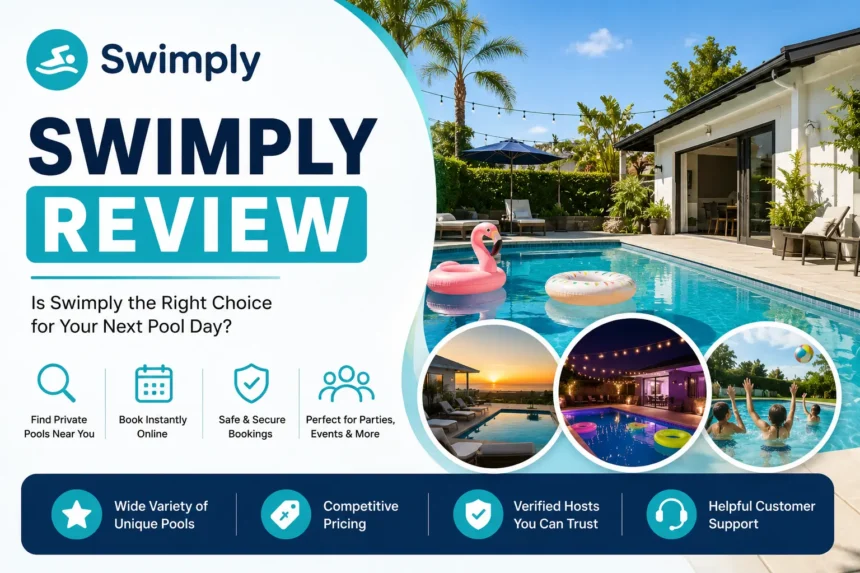
There was a time when renting a pool for a few hours usually meant booking a hotel, joining a club, or knowing someone lucky enough to have one in their backyard.
Swimply takes a different approach. Instead of owning the pool yourself, you can book time at someone else’s private pool.
It sounds slightly unusual the first time you hear about it. You’re essentially opening an app or website, finding a pool near you, choosing a date and time, paying for your booking, and then using that space for a few hours.
But once you think about it, the idea is pretty easy to understand.
Maybe you want a quiet afternoon with your family. Maybe you’re planning a birthday party and don’t want dozens of people inside your house. Or perhaps you simply want to swim without sharing the pool with a crowd of strangers.
That’s where Swimply comes in.
More Read

The important thing, though, is that Swimply isn’t a hotel or a traditional public swimming facility. The experience depends heavily on the individual property and host. One booking might give you a beautiful pool, comfortable seating, a grill and plenty of privacy. Another may be much more basic.
So this review is less about asking whether the idea behind Swimply is good. It clearly can be.
The more useful question is whether the actual experience is worth the money and what you should know before making your first booking.
What Is Swimply?
Swimply is a platform that connects people who have pools or other private spaces with people who want to rent them for a limited period.
The pool itself belongs to an individual host. Swimply provides the platform where the listing is displayed and where guests can browse available options and make bookings.
That means there is no single “Swimply pool experience.”
Every property can be different.
One host may have a large backyard pool designed for parties and group gatherings. Another might offer a smaller, quieter pool that is better suited to a couple or a small family. Amenities, house rules, privacy and pricing can all vary from one listing to another.
And honestly, that variety is both one of Swimply’s biggest strengths and one of the things you need to be careful about.
A public pool is generally predictable. You know you’re going somewhere specifically built for swimming, and the basic experience is usually similar each time.
With Swimply, you’re choosing an individual property.
That can make the experience much better—but it also means you need to spend a little more time looking at the listing before booking.
You can browse available listings through Swimply’s official website.
How Does Swimply Work?
The basic process is simple.
You search for a pool or available space in the area you want. After that, you can look through the available listings, compare prices, check photos, read the description and see what amenities are included.
Once you find something you like, you select your date and time, enter the number of guests and complete the booking process.
From the guest’s point of view, it feels a little like booking accommodation or a short-term activity, except you’re renting a private space for a few hours rather than staying overnight.
The details matter more than you might expect.
Before booking, I would pay close attention to things like:
Those things can completely change the experience.
A listing with great photos might look perfect until you realize that extra guests cost more, parking is limited, or certain amenities shown in the pictures aren’t included with the standard booking.
That doesn’t mean there is anything wrong with Swimply. It simply means you should treat each listing as its own rental rather than assuming every property works the same way.
Why Would Someone Rent a Private Pool?
At first glance, paying to use someone else’s backyard pool might seem unnecessary.
But there are quite a few situations where it makes sense.
A family may want to spend an afternoon swimming without joining a crowded public pool. A group of friends may want somewhere to relax during warm weather. Someone planning a birthday could prefer a private outdoor space instead of renting a large event venue.
Privacy is another obvious reason.
At a public pool, you’re sharing the space with whoever else happens to be there. Depending on the location, that could mean noise, crowds and limited seating.
With a private booking, the experience can feel much more relaxed.
You also don’t have to own and maintain a pool yourself—which, when you think about it, is probably the most expensive part.
You can enjoy having a pool for an afternoon and leave without worrying about cleaning it, maintaining the equipment or paying for repairs.
That convenience is really the foundation of the Swimply idea.
The First-Time Swimply Experience
I think the first booking is where most people will either become interested in using Swimply again or decide it isn’t for them.
The good news is that the concept itself isn’t complicated.
The difficult part is choosing the right listing.
If you’ve ever booked a hotel room based on photos and later discovered that the room looked much better online, you’ll understand why I would spend time reading the full description.
Photos are useful, but they don’t tell you everything.
For example, imagine two listings that both cost roughly the same amount.
The first has a beautiful pool, but there is very little shade, limited seating and no convenient restroom access.
The second pool might not look quite as impressive in photos, but it has comfortable seating, a shaded area, a clean bathroom and enough space for everyone in your group.
For an actual afternoon there, the second option could easily be the better experience.
That is why I wouldn’t book based only on the pool itself.
Look at the whole space.
What Kind of Pools Can You Find?
This is one of the more interesting parts of browsing Swimply.
The listings can range from simple residential pools to much larger and more elaborate backyard spaces.
Some are clearly designed with relaxation in mind. You might find lounge chairs, shaded areas and a quiet setting where a couple or small group can spend a few hours.
Others are more suitable for gatherings.
Depending on the property, you may come across additional features such as hot tubs, outdoor seating, grills, cabanas or other entertainment areas.
But this is where expectations need to stay realistic.
Not every pool is a luxury resort.
And that’s completely fine.
A basic, clean and private pool at a reasonable price might be exactly what you need. In fact, I would rather book a straightforward property with accurate photos and clear information than a listing that looks spectacular but leaves important details unclear.
The best listing isn’t necessarily the most expensive or the most photogenic one.
It’s the one that matches what you’re planning to do.
Is Swimply Only for Swimming?
No, and this is one reason the platform can be useful beyond a normal pool day.
Depending on the available listing and location, private spaces may be used for more than simply getting in the water.
A group might book a pool for a birthday celebration. A couple could use a quieter property for a relaxing afternoon. Families may want somewhere the children can swim while adults have space to sit and relax.
The pool becomes part of the experience rather than the only reason for booking.
That said, I would still check the listing rules carefully if you’re planning any kind of gathering.
A property that works perfectly for a family of four may not allow a group of 15 people with music, food and decorations.
And you don’t want to discover that after making the booking.
Privacy: One of Swimply’s Biggest Advantages
For me, privacy is one of the strongest reasons to consider Swimply.
Public pools can be fun, but they are not always relaxing.
You may have children splashing nearby, crowded changing areas, limited places to sit and a general feeling that you’re sharing the space with dozens of other people.
A private pool can be a completely different experience.
You’re with the people you came with.
You can relax, eat, talk and spend time without worrying about finding enough chairs or getting a good spot near the water.
Of course, “private” doesn’t necessarily mean every property feels completely isolated.
The host’s house may be nearby. Neighbours may overlook the backyard. Some listings may have more separation than others.
If privacy is particularly important to you, don’t just assume.
Look carefully at the photos and description, and check whether previous guests have mentioned the setting.
That extra five minutes of research can make a big difference.
Is Swimply Safe and Legit?
Swimply is a real rental platform, but that doesn’t mean every individual booking will be identical.
This is similar to booking accommodation through a marketplace: the platform provides the booking system, while the actual experience depends on the individual property and host.
That is why I wouldn’t approach Swimply as if you’re booking a standardized hotel room.
Read the listing.
Look at the photos.
Check the rules.
Pay attention to guest capacity and amenities.
And if something important is unclear, it’s better to clarify it before booking than to arrive and be disappointed.
For a first-time user, I would probably choose a listing with plenty of information rather than automatically going for the cheapest option.
A few good photos are nice, but detailed information is often more useful.
You want to know what you’re actually getting.
What I Like About the Swimply Concept
The idea works because it gives people access to something they may want occasionally but don’t need to own.
Not everyone has the space or money for a private pool.
Even people who do have access to one might not want the responsibility of maintaining it.
Swimply turns that into an on-demand experience.
Need a pool for three hours on a Saturday? Book one.
Want a private space for a small birthday gathering? Find a listing that allows it.
Just want to swim and relax without dealing with a crowded public pool? That can work too.
There is something appealing about paying only for the time you actually use.
Of course, whether it remains affordable depends on the property, location, number of guests and any additional costs.
Pricing, Fees, Pool Quality and What to Expect
The idea behind Swimply is easy to like. You find a private pool, book a few hours and enjoy it with your own group.
The part where things become less straightforward is the price.
A listing might initially look affordable, but the final cost can depend on the hourly rate, booking length, number of guests, taxes, service fees and any extras offered by the host. That doesn’t automatically make Swimply expensive. It just means the number you first see isn’t always the number you should use when deciding whether a booking is a good deal.
Swimply says most pools fall roughly between $25 and $100 per hour, with many listings around the $30–$60 range. The final price varies by property and location, and the booking total can also include service fees and applicable taxes.
So, is Swimply cheap?
Sometimes.
But it depends heavily on how you’re using it.
How Much Does Swimply Cost?
Let’s say you find a pool for $40 per hour and book it for three hours. The base rental would be $120 before any applicable fees, taxes or extras.
Now imagine you’re splitting that booking between six people.
Suddenly, the cost per person may feel quite reasonable for a private space.
But if you’re booking the same pool alone or with just one other person, the value calculation changes.
That is why I think Swimply makes the most sense when you look at the total experience, not just the hourly rate.
You’re not paying for admission to a crowded pool. You’re paying to reserve a private space for your group during a specific time slot.
For a family or small group, that can work out well. For a single person who simply wants to swim for an hour, a public pool may still be the cheaper option.
Swimply also currently offers a paid monthly Premium Pass with service-fee benefits on eligible bookings, although the exact benefits and thresholds should be checked before subscribing because platform terms can change.
The Biggest Mistake: Booking Based Only on the Hourly Rate
This is probably the easiest way to end up disappointed.
Imagine you find two pools.
One costs $30 an hour. The other costs $50.
At first, the cheaper one seems like the obvious choice.
But what if the $30 pool has very limited seating, no restroom, no shade and charges extra for additional guests?
Meanwhile, the $50 listing includes a larger pool, outdoor seating, a restroom and enough space for everyone.
For a three-hour family booking, the more expensive option could easily provide better value.
This is why Swimply isn’t really like buying a standard product where you can compare two nearly identical items by price alone.
Every listing is different.
Before booking, I would compare:
You don’t need to spend an hour researching one pool. But a few minutes of checking can prevent a bad booking.
What Amenities Can You Expect?
This is where Swimply can become much more interesting than simply renting a place to swim.
Some listings are basic: a pool, some outdoor space and not much else.
Others can include things like hot tubs, grills, speakers, seating areas or other features. Swimply notes that amenities vary by listing, and some hosts may offer premium extras at an additional cost.
That variety is great, but don’t assume that everything visible in the photos is automatically included in your booking.
If the listing shows a grill, check whether you’re actually allowed to use it.
If there is a hot tub, see whether access is included.
If you are planning a party, confirm that the number of guests you intend to bring is permitted.
This may sound obvious, but private rentals are more dependent on host-specific rules than a hotel or public facility.
The listing is your guide to what you are actually booking.
Pool Quality Can Vary a Lot
This is probably the most important thing to understand before using Swimply.
There is no single standard pool.
One property might feel like a small private resort. Another may simply be a clean residential pool in someone’s backyard.
Neither is automatically better.
It depends on what you want.
If you’re planning a birthday party with ten people, you may need plenty of seating, a larger deck area and access to a restroom.
If you’re booking a quiet afternoon for two, a smaller pool in a peaceful backyard might be perfect.
The problem comes when your expectations don’t match the property.
That’s why I would always look at more than the main promotional photo.
Check multiple images. Read the description. Look for recent guest feedback where available.
The goal is not to find the most luxurious pool.
It’s to find the one that suits your plans.
Is Swimply Good for Families?
Yes, potentially—but the individual listing matters a lot.
For families, a private pool can be much more relaxing than a crowded public facility. You have your own space, children can play without competing for room with dozens of other swimmers, and adults can relax nearby.
But I would pay close attention to safety and the setup.
If you’re bringing young children, look at the pool’s layout, depth information where available, rules and overall environment. Swimply’s host terms require hosts to maintain their venues for guest health and safety and address measures such as water treatment, fencing or other reasonable security measures, subject to applicable rules and the particular property.
That said, no platform policy replaces normal supervision.
A private pool is still a pool.
If children are swimming, adults need to stay alert regardless of how impressive the property looks.
Swimply for Parties and Birthdays
This is one of the situations where Swimply can offer particularly good value.
Renting a traditional event venue can be expensive. Booking a hotel space may involve additional charges. Hosting a group at home can also mean cleaning, preparing and dealing with everyone afterward.
A private pool rental can offer a different option.
You have a place to gather, swim and spend a few hours together without permanently taking over someone’s house—or your own.
But this is where reading the rules becomes absolutely essential.
Not every host wants a party at their property.
Some listings may limit guest numbers. Others may have rules about music, alcohol, decorations or the use of certain outdoor spaces.
Don’t assume that “private pool” automatically means “party venue.”
If you’re planning a birthday or group event, book a property that clearly suits that purpose.
The Host Experience Matters More Than You Think
Because Swimply is a marketplace, the host plays a major role in the experience.
Some hosts may provide detailed instructions, easy access information and clear rules. Others may communicate less effectively.
A great property can still become frustrating if you’re confused about where to park, how to enter or what areas you’re allowed to use.
Swimply states that hosts set their own rules and availability, while booking details and access information are provided for confirmed bookings.
For that reason, I would pay attention to how clearly the listing is written.
A host who explains the property properly is usually easier to understand before you arrive.
That doesn’t guarantee a perfect experience, of course, but vague listings can create unnecessary surprises.
What Happens if You Need to Cancel?
This is another area where I wouldn’t make assumptions.
Swimply’s terms say that guest refunds are generally determined by the cancellation policy applicable to the booking. In other words, you should check the cancellation terms attached to the specific listing or booking before paying.
That matters because weather can be unpredictable.
If you’re booking an outdoor pool and the forecast changes, you don’t want to discover afterward that the cancellation rules don’t work for your situation.
Before confirming a booking, I would check:
This isn’t something unique to Swimply. The same advice applies to hotels, tours and event bookings.
But it is especially relevant when your entire booking depends on good weather.
Is Swimply Better Than a Hotel Pool?
It depends on what kind of experience you want.
A hotel pool usually comes with more consistency. You know you’re dealing with a commercial property, and there may be staff available if something goes wrong.
The downside is that you’re usually sharing the pool with other guests.
Swimply gives you the opposite experience.
You may have much more privacy, but the property itself varies from host to host.
For a quiet family afternoon or a small gathering, I can see Swimply being more enjoyable than a hotel pool.
For someone who wants predictable facilities and a standardized experience, a hotel may feel safer and simpler.
Neither option is automatically better.
It depends on whether privacy or consistency matters more to you.
Swimply vs a Public Pool
This comparison is much easier.
Public pools usually win on price.
Swimply usually wins on privacy.
At a public pool, you pay less, but you may deal with crowds, limited space and fixed operating hours.
With Swimply, you’re paying more for the ability to reserve your own space.
If you’re going alone for a quick swim, a public pool may make more sense.
If six friends want to spend an afternoon together without sharing the pool with strangers, Swimply can offer a completely different experience.
So I wouldn’t think of Swimply as a replacement for every public pool visit.
It’s more like an occasional upgrade.
What About Safety?
Swimply is a booking platform, but guests still need to use common sense.
Check the property.
Follow the house rules.
Don’t exceed the allowed guest limit.
Pay attention to pool safety.
Swimply’s terms place safety-related responsibilities on hosts, including maintaining venues and following applicable requirements, while also making clear that guests have responsibilities when using booked venues.
One thing worth remembering is that a private pool does not automatically mean there is a lifeguard present.
In fact, the host safety requirements referenced in Swimply’s terms include appropriate notice where no lifeguard is on duty.
So if you’re booking with children or inexperienced swimmers, supervision is especially important.
Families, Parties, Groups and Real-World Experience
By now, the basic idea behind Swimply is clear. You can book a private pool or space for a few hours instead of owning one yourself.
But whether Swimply is actually worth using depends a lot on who you’re booking it with and what you’re planning to do.
A quiet afternoon with two people is very different from a child’s birthday party. A family with young children has different needs from a group of friends looking for a place to spend a summer afternoon.
This is where Swimply becomes either a really useful service or an unnecessarily expensive one.
The trick is knowing which situation you fall into.
Swimply for Families
For families, a private pool can be much more appealing than a crowded public one.
Anyone who has visited a busy pool during summer knows how quickly the experience can become exhausting. Finding somewhere to sit, keeping an eye on children and dealing with dozens of other people can take away from what was supposed to be a relaxing day.
With the right Swimply property, you have your own space.
The kids can swim while the adults sit nearby. You don’t have to compete with strangers for chairs, and you can spend time together without feeling rushed by a crowded environment.
That said, I would be selective about the listing.
For a family booking, I wouldn’t just look for the nicest pool photo. I would check whether there is enough shade, comfortable seating, restroom access and a suitable area for children.
The size and layout of the pool also matter.
A beautiful deep pool may not be the best choice for younger children. Likewise, a large backyard might look impressive but offer very little comfortable space for parents to relax.
The best family-friendly Swimply booking is probably one where the whole space works—not just the pool.
Swimply for Couples
This is a completely different experience.
For a couple, Swimply can feel more like booking a private escape for a few hours.
Instead of going to a crowded hotel pool or public facility, you can potentially find a quieter setting where you have the space to yourselves.
This could work particularly well for a relaxed weekend afternoon, a special occasion or simply a change from the usual restaurant or movie plans.
Of course, value is the main consideration here.
If only two people are splitting the cost, a private pool rental can feel expensive compared with a public swimming pool.
But you’re paying for privacy and the overall setting.
If the property includes comfortable outdoor space and other useful amenities, the experience may justify the cost. If you’re only interested in swimming for 30 minutes, probably not.
For couples, I would choose Swimply based more on atmosphere than pool size.
A smaller, peaceful property may be more enjoyable than a huge pool designed for parties.
Swimply for Birthdays and Parties
This is one of the situations where Swimply can make a lot of sense.
Hosting a party at home can be stressful. You have to prepare the space, clean before everyone arrives and then deal with everything afterward.
Traditional event venues can also be expensive.
A private pool rental sits somewhere in between.
You can book the space for a few hours, invite your group and enjoy the event without permanently taking over your own home.
But this is also where you need to read the rules very carefully.
Not every Swimply host allows parties.
And even when parties are permitted, there may be restrictions on:
Don’t assume that a large pool automatically means you can invite 20 people and throw a party.
Choose a listing that clearly suits group events.
If you’re planning a birthday, I would also think about the practical side. Is there enough seating? Is there shade? Where will people leave their bags? Is there a restroom? Can guests eat comfortably?
A pool alone doesn’t automatically make a good party venue.
Swimply for Groups of Friends
This might be where the value is easiest to understand.
Let’s say a group of friends wants to spend an afternoon together.
Going to a public pool means sharing the space with everyone else. Booking a hotel may not be practical. And not everyone has a backyard pool available.
With Swimply, the group can split the total cost.
That changes the value equation quite a bit.
A booking that feels expensive for one person may become reasonable when divided among several people.
The bigger advantage, though, is that the experience is built around your group.
You can swim, relax, talk and spend time together without dealing with a crowded public environment.
For groups, I would pay close attention to the guest limit before booking.
Don’t try to save money by booking for fewer people and bringing extra guests anyway. Private properties have rules for a reason, and the host needs to know how many people will actually be using the space.
What Can Go Wrong With a Swimply Booking?
Even a good concept can lead to a disappointing experience if expectations don’t match reality.
The biggest risk with Swimply is assuming too much from photos.
A listing might show a beautiful pool, but photos don’t always tell you how private the space feels, how much seating is available or whether the property is convenient for your group.
Another possible issue is communication.
You don’t want to arrive at the location and be confused about parking, entry or which areas you are allowed to use.
Then there is the weather.
An outdoor pool booking can look like a perfect idea until the forecast changes.
That’s why I would check the cancellation or rescheduling terms before booking rather than after something goes wrong.
I would also avoid booking a property that provides very little information unless the details you need are clearly confirmed beforehand.
The best listings usually make it easier for guests to understand exactly what they’re paying for.
Customer Experience Can Vary
This is probably the most important thing to remember about Swimply.
You’re not reviewing one physical location.
You’re using a platform that gives you access to many different properties.
One guest may have an excellent experience with a friendly host, a beautiful pool and clear instructions.
Another may book a completely different property and have a less impressive experience.
That doesn’t necessarily mean one person is wrong.
Both experiences can be real.
This is why I would focus on the exact listing instead of searching for a general answer to whether every Swimply pool is good.
Look at the available information for the property you’re considering.
If previous guest feedback is available, it can also help you understand whether the photos and description match the actual experience.
A listing with clear information and consistent feedback is usually easier to book confidently than one that leaves you guessing.
Swimply vs Public Pools
The main difference comes down to privacy.
Public pools are generally the practical choice if you simply want to swim.
They’re often cheaper and don’t require you to compare dozens of private listings.
Swimply is more about the overall experience.
You’re reserving a space rather than buying access to a shared facility.
If you want to exercise or swim for a short period, a public pool may offer better value.
If you’re planning a family afternoon or want to spend several hours with friends, Swimply can offer something that a public pool can’t: your own space.
So I don’t think these two options are direct replacements for each other.
They serve different purposes.
Swimply vs Hotels
Hotels can offer a more predictable experience.
There may be staff on-site, standardized facilities and other services available.
The downside is that you generally share the pool with other guests.
With Swimply, the individual property may be less predictable, but you can have far more privacy.
For a group that only wants pool access for a few hours, renting a private space may be more practical than booking hotel rooms just to use the pool.
On the other hand, if you want overnight accommodation, food, additional facilities and a more traditional hospitality experience, a hotel obviously makes more sense.
Swimply is not really trying to replace a hotel stay.
It’s more useful when the private pool itself is the main attraction.
Swimply vs Traditional Event Venues
For birthdays and small celebrations, this comparison is worth considering.
A traditional venue gives you a more controlled event environment. You may have dedicated staff, tables, indoor space and services.
But it can also be expensive.
A Swimply property may be more relaxed and informal.
You’re not renting a banquet hall. You’re booking someone’s private pool or outdoor space.
That can make the event feel more personal, especially during warm weather.
The downside is that you need to check what the host actually allows.
A venue built specifically for events will usually have fewer questions around capacity, parking and facilities. With Swimply, those details can vary significantly.
So if you’re planning something simple and casual, Swimply can be an interesting option.
For a large or formal event, a dedicated venue may still be the safer choice.
The Best Type of Swimply User
After looking at different situations, I think Swimply works best for people who want more than just a place to swim.
The ideal user is probably someone planning an experience.
A family wants a private afternoon together.
A group of friends wants somewhere to spend a few hours.
A couple wants a quiet place to relax.
Someone is planning a small birthday celebration.
In those situations, you’re paying for the space, privacy and atmosphere—not just the water.
That’s when the cost can start to make more sense.
If you only want to do laps for an hour, there are probably cheaper alternatives.
Pros and Cons
Pros
Cons
Who Should Consider Using Swimply?
I would recommend looking at Swimply if you want to book a private pool for a specific occasion rather than simply looking for the cheapest possible place to swim.
It can work well for:
The platform makes the most sense when the privacy and space are part of the reason you’re booking.
So, Is Swimply Actually Worth the Money?
It can be, especially when the cost is shared.
Let’s imagine two different situations.
In the first, one person books a private pool for a short amount of time just to go swimming. Depending on the price of the listing, that could feel expensive.
In the second, six friends book the same type of pool for several hours and split the cost. Suddenly, the experience may feel much more reasonable.
You also have to consider what you’re getting beyond the pool itself.
A good property may give you outdoor seating, shade, space to relax and a private environment where you can spend time with your own group.
That’s very different from paying an entry fee to a crowded public pool.
So I wouldn’t ask, “Is Swimply cheaper than a public pool?”
Usually, that isn’t the right comparison.
The better question is:
“Is having a private pool and space for a few hours worth the extra money for my group?”
For many people, the answer will be yes.
The Best Way to Get Value From Swimply
The biggest mistake would be choosing the first cheap listing you see.
A low hourly rate doesn’t always mean you’re getting the best deal.
Before booking, look at the entire experience.
How many people are coming?
How long do you want to stay?
Is there enough seating?
Do you need shade?
Is restroom access important?
Are food and drinks allowed?
Does the property actually allow parties?
And, most importantly, does the total price still make sense after everything is included?
I think the best Swimply bookings are the ones where you already know exactly what kind of day you’re planning.
If you know you’re bringing four family members and want a quiet afternoon, finding the right pool becomes much easier.
If you’re planning a birthday for 10 people, you can focus on listings that clearly allow groups and have enough space.
The more specific you are about your needs, the better chance you have of finding a property that actually feels worth the money.
What I Would Check Before Booking
If I were booking a Swimply pool for the first time, I would spend a few extra minutes checking the details.
Not obsessively—but enough to avoid surprises.
I would check the total booking price rather than only the advertised hourly rate.
I would also confirm the guest limit. If six people are coming, I would make sure the listing actually allows six people.
The amenities would matter too.
A pool can look amazing in photos, but if you’re spending four hours there, you might care more about shade, seating and restroom access than the pool’s appearance.
Privacy is another thing I would check carefully.
Some properties may feel completely secluded, while others may be in a typical residential backyard with nearby homes.
Neither is necessarily a problem. It just depends on what you’re expecting.
And finally, I would always check the cancellation terms before booking.
Outdoor plans can change quickly.
Is Swimply Better Than a Public Pool?
Not necessarily.
It’s better for a different type of experience.
A public pool is usually the practical option when you simply want to swim.
Swimply is better suited to people who want private space.
If you enjoy swimming regularly and just want access to water, paying for a public pool or membership may offer better value.
But if you’re planning a family day, a get-together or a small celebration, a private booking can feel much more special.
You don’t have to compete for space.
You don’t have strangers sitting next to your group.
And you can choose a property that fits your plans.
So, for me, the biggest difference is this:
Public pools are about swimming. Swimply can be about the entire day.
Is Swimply Good for Parties?
It can be, but this is where choosing the right listing is essential.
Don’t assume every private pool can be used for a birthday party.
Some hosts may prefer quiet bookings. Others may allow larger groups and celebrations.
Before booking, make sure the listing matches what you’re planning.
Check the guest capacity.
Check whether music is allowed.
Check whether food and drinks are permitted.
And if there is anything important that isn’t clear, confirm it before finalizing the booking.
For a casual summer birthday or small group gathering, Swimply can be a fun alternative to renting a traditional venue.
The best part is that the pool gives people something to do.
You’re not just sitting around a table for three hours.
People can swim, relax, eat and spend time together.
Is Swimply Good for Families?
I think this is one of the strongest use cases.
A family can book a private space and spend a few hours together without dealing with a crowded pool.
Parents can sit nearby while children play. Everyone in the group has their own space, and the experience can feel more relaxed.
Of course, the property needs to be suitable.
If you’re booking with young children, look beyond the photos and think about the actual setup.
A beautiful pool isn’t automatically family-friendly.
Check the available information, follow the property rules and make sure adults provide appropriate supervision.
If you find the right property, though, Swimply can make a regular weekend feel like a mini vacation.
Who Should Use Swimply?
Swimply is probably a good fit for you if:
Who Might Want to Skip Swimply?
I would probably look for another option if:
There is nothing wrong with Swimply in these situations. It just might not be the most practical choice.
My Overall Swimply Rating
| Category | Rating |
|---|---|
| Ease of Booking | 4.5/5 |
| Privacy | 4.8/5 |
| Variety of Listings | 4.6/5 |
| Family Experience | 4.5/5 |
| Group Experience | 4.7/5 |
| Party Potential | 4.4/5 |
| Value for Money | 4.2/5 |
| Overall Experience | 4.5/5 |
⭐ Overall Rating: 4.5/5
The biggest reason for the high rating is that Swimply offers something genuinely useful.
You don’t need to own a pool to enjoy one privately.
At the same time, the experience depends heavily on the individual listing. That’s why I wouldn’t book without reading the details carefully.
A great property can give you an excellent private pool day.
A poorly chosen one may not feel worth the money.
Frequently Asked Questions
What is Swimply?
Swimply is a platform where people can book private pools and other spaces for a specific period of time.
Is Swimply worth it?
Swimply can be worth it if you value privacy or are splitting the cost with family or friends. It may be less appealing if you simply want the cheapest place to swim.
Is Swimply good for birthday parties?
Yes, some properties can work well for birthdays and small gatherings. However, you should always check whether the host allows parties and confirm the guest limit.
Can families use Swimply?
Yes. Swimply can be a good option for families looking for a private pool experience. The individual property should be checked to make sure it suits your family’s needs.
Is every Swimply pool private?
Privacy can vary depending on the individual property. Check the listing photos and description to understand the setting before booking.
How long can you rent a Swimply pool?
Available booking times can vary depending on the host and listing.
Can you bring food and drinks?
That depends on the individual property’s rules. Always check the listing before bringing anything.
Is Swimply better than a public pool?
It depends on what you want. Public pools are generally better for affordable, regular swimming, while Swimply is better for a private experience with family or friends.
Final Thoughts
I like the basic idea behind Swimply because it gives people access to something they may only want occasionally.
Owning a pool is expensive.
Maintaining one takes time.
And for many people, it simply isn’t realistic.
Swimply gives you the chance to enjoy the experience without any of the long-term responsibility.
The key is not to treat every listing the same.
Choose carefully.
Think about what you’re planning to do, how many people are coming and what amenities actually matter to you.
If you find the right property, Swimply can be a really enjoyable option for a family day, a group gathering or simply a quiet afternoon by the pool.
My final verdict: Swimply is worth trying if you value privacy and choose the right listing. It’s not the cheapest way to go swimming, but for the right occasion, it can offer a much better overall experience.