


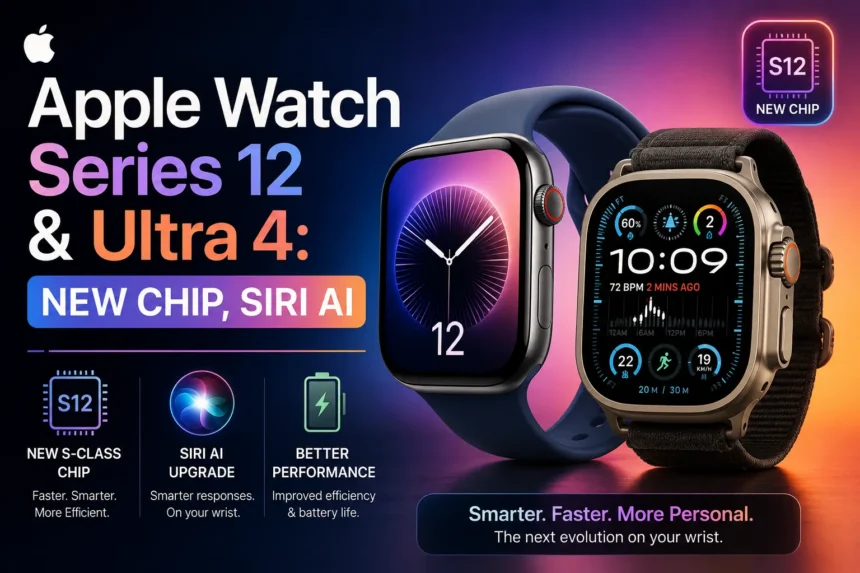
Apple appears to be preparing for a significant Apple Watch refresh this September, and the biggest improvement may not be something you can immediately see.
The upcoming Apple Watch Series 12 and Apple Watch Ultra 4 are expected to bring a new-generation S-class chip, potentially delivering the kind of performance improvement that Apple Watch users have been waiting for. The timing could be particularly important because Apple is also preparing watchOS 27, which introduces its next-generation Siri AI experience powered by Apple Intelligence.
Unlike a traditional smartwatch update focused mainly on display changes, health sensors or battery life, this year’s Apple Watch generation could be about what happens underneath the case.
Apple has confirmed that Siri AI is coming to Apple Watch with watchOS 27. The company describes it as a more capable, conversational assistant that can understand personal context, answer broader questions, interact with apps and continue conversations across Apple devices.
That makes a faster processor potentially more important than ever.
Recent reports indicate that Apple is already in late-stage testing of the Series 12 and Ultra 4, with the new watches expected to be announced in September. Bloomberg’s Mark Gurman has also reported that Apple is focusing on improvements inside the devices, including a long-awaited increase in chip performance and speed.
More Read

Apple Watch Series 12 and Ultra 4: The Chip Upgrade Could Be the Real Story
Apple’s yearly Apple Watch launches can sometimes make the processor naming look more impressive than the actual performance difference.
The company frequently introduces a new S-series chip designation, but that does not necessarily mean users receive a major CPU performance increase every year. Apple Watch hardware has generally evolved through relatively incremental processor improvements, with larger performance jumps appearing less frequently.
The recent generation is a good example.
The Apple Watch Series 11, Apple Watch Ultra 3 and Apple Watch SE 3 all use the S10 chip. That meant Apple did not introduce a new S-class processor with those 2025 models. According to MacRumors, Apple is now expected to introduce a new chip with the Series 12 and Ultra 4 after that one-year pause.
The exact branding remains uncertain.
The processor could be called S11, or Apple could use another naming convention. At this stage, the important part isn’t the name. It is whether the new chip delivers a meaningful improvement in CPU and overall system performance.
That distinction matters because Apple Watch is entering a new software era.
The arrival of Siri AI means the Apple Watch is no longer simply being asked to handle notifications, fitness tracking, apps and conventional voice commands. Apple is positioning Siri as a conversational AI assistant capable of handling more complicated requests and working with information from across the user’s digital life.
A faster processor could therefore make the new watches feel considerably more responsive.
Siri AI Changes What Apple Watch Needs From Its Hardware
For years, Siri on Apple Watch has largely been a quick voice assistant for simple tasks.
Users could ask for the weather, start a timer, send a message, check information or perform basic actions. Those capabilities are useful, but they don’t necessarily require the same type of processing workload associated with modern generative AI.
Siri AI is different.
Apple says the new Siri is powered by Apple Intelligence and supports natural, back-and-forth conversations. It can answer open-ended questions, help with workout ideas, access personal context, interact with applications and retrieve information from the web.
Apple is also introducing a dedicated Siri app on Apple Watch.
That is a major change in how the company envisions Siri being used on the wrist.
Instead of treating Siri as a small voice-command feature that disappears after completing one action, Apple is turning it into a more persistent AI experience.
For example, Apple says users will be able to ask Siri AI to find information from personal content, perform actions in apps, provide answers based on online information and continue conversations across Apple devices.
All of this raises an obvious question:
Can older Apple Watch hardware deliver that experience smoothly?
Apple’s answer appears to be partly reflected in the watchOS 27 compatibility list.
watchOS 27 Has a Much More Demanding Hardware Requirement
watchOS 27 is not compatible with every Apple Watch that currently runs watchOS 26.
Apple’s official compatibility list includes the Apple Watch Series 9, Series 10, Series 11, Ultra 2, Ultra 3 and SE 3, along with the upcoming generation expected to arrive later this year.
That means several older models are being left behind.
Apple has confirmed that watchOS 27 drops support for the Apple Watch Series 6, Series 7, Series 8, first-generation Apple Watch Ultra and Apple Watch SE 2. Those devices will not receive the full new watchOS experience.
The cutoff is significant because Apple is effectively placing much greater emphasis on hardware performance.
Apple’s own explanation is straightforward: performance and power requirements influence which devices can deliver the intended experience.
That does not mean every new Siri AI operation is processed directly on the Apple Watch.
In fact, Apple Intelligence is designed as a combination of on-device processing and Apple’s cloud-based Private Cloud Compute architecture depending on the task. The Apple Watch also requires a compatible iPhone nearby for Apple Intelligence and Siri AI features. Apple says Siri AI and Apple Intelligence on Apple Watch require supported Apple Watch hardware paired with an Apple Intelligence-enabled iPhone nearby.
Still, the Apple Watch needs to manage the interface, voice interaction, app integration, context handling and communication efficiently.
That makes processor performance increasingly important.
Why the Timing of the New Chip Makes Sense
The timing is arguably the most interesting part of Apple’s strategy.
Apple is expected to introduce the Series 12 and Ultra 4 around the same period that watchOS 27 moves toward its public release. Meanwhile, Siri AI is scheduled to become available later this year in English.
In other words, Apple is effectively introducing a new software platform and new hardware generation together.
That is exactly when a processor upgrade makes the most sense.
Imagine buying a new Apple Watch with an unchanged processor just as Apple introduces a significantly more capable AI assistant. The hardware might technically support the feature, but the experience could become more dependent on network conditions, paired-device processing and software optimization.
A faster chip gives Apple more headroom.
It could help reduce delays when launching Siri, processing voice input, switching between applications and rendering more sophisticated interfaces. It may also improve the overall responsiveness of watchOS 27.
For users, that could be more noticeable than a small increase in benchmark scores.
Siri AI Could Become One of the Biggest Reasons to Upgrade
Apple Watch upgrades have traditionally been driven by several categories: health sensors, battery improvements, displays, durability, connectivity and design.
This year, AI could become another major upgrade category.
Apple’s official watchOS 27 preview shows that Siri AI isn’t simply receiving a minor visual refresh. Apple describes it as a conversational assistant capable of richer answers and natural conversations. It can also understand personal context and perform actions across apps.
Consider how that changes everyday Apple Watch usage.
Instead of opening multiple apps, a user could potentially ask Siri to retrieve information, start a workout-related task, access a saved detail or perform an action.
Apple’s examples include setting Activity goals, getting directions, reading upcoming events, sending information and controlling media.
That could make the Apple Watch more useful as a standalone interaction device.
The screen is small. That’s always been one of the Apple Watch’s limitations.
AI can help solve that problem.
Rather than navigating through multiple menus on a tiny display, users can communicate with the device conversationally.
The better Siri becomes, the less users may need to interact with the touchscreen for certain tasks.
Apple Watch Series 12 Could Be More About Speed Than Design
Don’t expect this year’s Apple Watch to necessarily look dramatically different.
Current reporting suggests Apple is not planning a major design overhaul for the new models. Instead, the company is reportedly concentrating on improvements inside the devices, including health and fitness tracking and processor performance.
That is an important distinction for potential buyers.
The Series 12 may look familiar.
The Ultra 4 may also retain the recognizable rugged design that has become synonymous with Apple’s high-end smartwatch.
But the internal hardware could be significantly different.
This strategy isn’t unusual for Apple. Once a product’s external design reaches a mature stage, the company can focus on processors, sensors, software and efficiency rather than changing the physical appearance every year.
For the Apple Watch, that approach could actually be beneficial.
The current design is already compact, recognizable and highly functional. A major redesign isn’t necessarily required if Apple can make the device faster and smarter.
What About Apple Watch Ultra 4?
The Apple Watch Ultra 4 could benefit from the same processor upgrade, but its target audience makes performance improvements particularly interesting.
The Ultra line is aimed at users who want a more rugged and feature-rich Apple Watch, with an emphasis on outdoor activities, fitness and longer-duration use.
A faster chip could help with navigation, workout processing, app responsiveness and the more advanced features coming with watchOS 27.
There have also been reports suggesting that Apple could eventually make a more substantial design change to the Ultra line, although the exact scope and timing remain uncertain. MacRumors reported that a May 2026 DigiTimes report pointed toward the possibility of a full redesign, while noting that the details were unclear.
For now, the more consistently reported expectation is that the Ultra 4 will arrive alongside the Series 12.
Bloomberg’s Mark Gurman has identified both models as part of Apple’s expected September product lineup.
The S11 vs S12 Name Doesn’t Matter as Much as Performance
There is already some speculation over what Apple will call the new processor.
S11 would be the obvious progression after S10.
But reports have also suggested that the chip could carry a different designation.
For consumers, however, the name is largely irrelevant.
What matters is whether Apple can deliver a noticeable improvement.
A genuinely faster processor could improve several aspects of the Apple Watch experience:
The final performance characteristics will only become clear once Apple officially announces the hardware and independent testing becomes available.
Until then, the processor should be viewed as one of the most important expected upgrades rather than a confirmed specification.
Apple Watch Users May Finally Feel a Real Speed Difference
One reason this rumored chip upgrade is interesting is that Apple Watch performance has reached a point where small processor changes aren’t always obvious.
The Series 9, Series 10 and Series 11 generations already feel relatively fast for everyday smartwatch tasks.
That means Apple needs more than a slightly higher benchmark number to make the new processor meaningful.
Siri AI provides a perfect opportunity.
AI workloads and conversational interfaces are substantially more demanding than traditional smartwatch interactions. Even when processing is distributed between the Watch, iPhone and cloud infrastructure, the device still has to respond quickly and maintain a smooth user interface.
If Apple gets that balance right, the Series 12 could feel meaningfully faster without requiring a radical external redesign.
That could also explain why this year’s processor upgrade is arriving now rather than last year.
The software has finally caught up with the hardware requirements.
What Existing Apple Watch Owners Should Know
The arrival of a new chip does not automatically make existing Apple Watches obsolete.
Apple’s watchOS 27 compatibility list confirms that several relatively recent models—including Series 9, Series 10, Series 11, Ultra 2, Ultra 3 and SE 3—will receive the new operating system.
So if you already own one of those models, you should still get access to watchOS 27 and its supported features.
However, there could still be differences in performance.
The Series 12 and Ultra 4 are expected to have newer processors, while existing compatible models will continue using their current chips.
That means the newest watches could potentially provide a faster or smoother experience, especially as Apple expands AI capabilities.
It also creates an interesting situation for buyers considering a discounted Series 11 or Ultra 3.
Those watches may remain excellent options, particularly if their prices fall after the new models launch.
But anyone specifically interested in Siri AI and long-term performance may have a stronger reason to wait for the new generation.
The Bigger Picture: Apple Watch Is Entering Its AI Era
The most important thing about the Series 12 and Ultra 4 may not be the watches themselves.
It could be what they represent.
Apple is gradually integrating Apple Intelligence throughout its ecosystem.
The company has already announced its next generation of Siri, describing it as more intelligent, conversational and capable of understanding personal context.
The Apple Watch is now becoming part of that strategy.
That changes the role of the smartwatch.
Instead of being primarily a companion for notifications, fitness and health tracking, the Apple Watch can become another interface for Apple’s AI ecosystem.
The wrist is actually an ideal location for an assistant.
You don’t need to pull out your phone.
You don’t need to unlock a device.
You can simply raise your wrist and ask a question.
But that convenience only works if the response is fast.
Nobody wants to wait several seconds for a basic interaction with a smartwatch.
This is where the rumored new S-class chip could become much more important than it initially appears.
Apple Watch Series 12 and Ultra 4: What We Expect
Based on current reports and Apple’s confirmed software roadmap, the two new watches are expected to share several broad characteristics.
Apple Watch Series 12:
The standard flagship Apple Watch is expected to receive a new-generation processor, health and fitness improvements and watchOS 27. A major external redesign is not currently expected.
Apple Watch Ultra 4:
The premium rugged model is also expected to receive the new chip, alongside further health, fitness and performance improvements. Reports have pointed to a September launch, although Apple has not yet officially announced the complete hardware specifications.
Siri AI:
Both new models should be positioned to take advantage of watchOS 27’s new Siri AI experience, subject to Apple’s final feature availability and regional/language requirements.
Chip name:
S11 or S12 remains uncertain. The important expectation is a genuine performance improvement over the S10 generation.
Should You Wait for Apple Watch Series 12?
If you’re currently planning to buy an Apple Watch and don’t need one immediately, waiting makes sense.
The Series 12 and Ultra 4 are expected to be announced in September, and the combination of new hardware and watchOS 27 makes this a particularly interesting generation. Current reporting points toward a September launch, while Apple itself has confirmed the upcoming software platform and Siri AI capabilities.
Existing Apple Watch owners have a different decision.
If you have a Series 9 or newer model, you are not being left behind by watchOS 27. Apple has confirmed support for those generations.
But if your current Watch is older, the new generation could be a much more compelling upgrade.
The biggest reason isn’t necessarily the design.
It’s the combination of new processor + AI-focused software + longer-term performance headroom.
Final Verdict
Apple Watch Series 12 and Apple Watch Ultra 4 could arrive at an unusually important moment for Apple’s wearable platform.
After a period in which Apple Watch processor improvements have been relatively modest, reports point toward a new S-class chip arriving with this year’s models. The exact name remains unclear, but the expected performance boost could be much more meaningful because it coincides with the arrival of Apple’s new Siri AI experience.
Apple has already confirmed that watchOS 27 will bring Siri AI to compatible Apple Watch models, with richer conversations, personal-context awareness, app actions and access to broader online knowledge.
That makes the rumored Series 12 and Ultra 4 chip upgrade particularly well timed.
The new watches don’t necessarily need a dramatic redesign to feel new.
If Apple can combine a faster processor with smooth watchOS 27 performance and genuinely useful Siri AI interactions, the Series 12 and Ultra 4 could represent one of the more important Apple Watch upgrades in recent years.
And that may be the real story of Apple’s 2026 smartwatch lineup: the Apple Watch isn’t just getting faster—it is preparing to become considerably smarter.
Apple Watch Series 12 and Ultra 4 FAQs
When will Apple Watch Series 12 and Ultra 4 launch?
Apple has not yet officially announced the launch date, but current reporting points to a September 2026 announcement alongside Apple’s new iPhone lineup.
Will Apple Watch Series 12 get a new chip?
Reports indicate that the Series 12 and Ultra 4 are expected to receive a new-generation S-class chip after the S10 remained in the previous generation. The final chip name and specifications have not been confirmed by Apple.
Will Apple Watch Ultra 4 have a new processor?
Yes, current reports indicate that the Ultra 4 will receive the same major internal performance focus as the Series 12, including a new chip.
Will Siri AI work on Apple Watch?
Yes. Apple has officially announced Siri AI for watchOS 27. It will offer more conversational interactions, personal-context capabilities, app actions and broader knowledge. Apple says availability will initially be in English and that an Apple Intelligence-enabled iPhone nearby is required for Apple Watch.
Which Apple Watches support watchOS 27?
Apple’s current list includes Apple Watch Series 9, Series 10, Series 11, Ultra 2, Ultra 3 and SE 3.
Is Apple Watch Series 11 still worth buying?
It could remain a good option, particularly if its price drops after the Series 12 launches. However, buyers who prioritize the newest processor and maximum future performance may want to wait for the Series 12.