




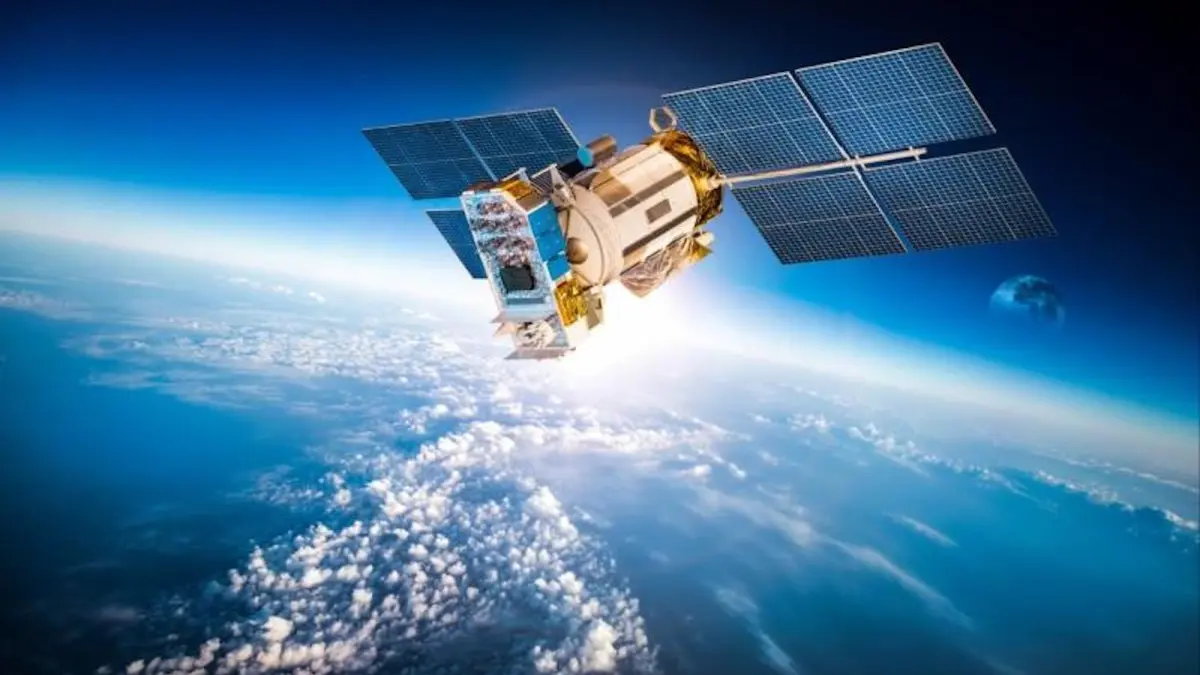

The increasingly crowded environment of low Earth orbit (LEO) faced another alarming moment last week when a Starlink satellite narrowly avoided a collision with a newly launched Chinese spacecraft. The incident, which reportedly brought the two satellites within just a few hundred meters of each other, has triggered renewed debate over space safety, international coordination, and the risks posed by the rapid expansion of satellite constellations.
According to SpaceX, the close approach involved STARLINK-6079, operating at an altitude of approximately 560 kilometers, and one of nine satellites deployed from China’s Jiuquan Satellite Launch Center. SpaceX officials claim the Chinese satellite operator failed to share essential orbital location data, making it impossible for Starlink’s automated collision avoidance systems to respond in time.
SpaceX Blames Lack of Transparency
Michael Nicolls, Vice President of Starlink Engineering, publicly addressed the issue, warning that such incidents are becoming more dangerous as Earth’s orbital space grows increasingly congested.
“When satellite operators do not share ephemeris for their satellites, dangerously close approaches can occur,” Nicolls stated. He emphasized that no known coordination or deconfliction measures were taken prior to the satellite deployment, resulting in an estimated 200-meter near miss—a distance considered extremely close in orbital terms.
Starlink satellites are equipped with advanced autonomous maneuvering systems designed to avoid collisions with tracked objects. However, these systems rely heavily on accurate and shared positional data. If a satellite’s trajectory is unknown or unreported, avoidance becomes significantly more difficult.
Starlink’s Growing Maneuver Load
The scale of the challenge is underscored by Starlink’s own data. In the first half of 2025 alone, Starlink satellites reportedly executed over 144,000 collision avoidance maneuvers, reflecting the sheer density of objects now operating in LEO.
With roughly 9,000 Starlink satellites currently active, SpaceX operates the world’s largest satellite constellation. While this network enables global broadband connectivity, it also places immense pressure on space traffic coordination systems that were never designed for tens of thousands of spacecraft.
Chinese Operator Responds
The satellite involved in the incident was launched by CAS Space, a commercial space company based in Guangzhou, China. In response to SpaceX’s claims, CAS Space stated that it follows mandatory launch safety procedures and uses ground-based space awareness systems to select launch windows that avoid known satellites and debris.
The company also appeared to distance itself from responsibility, noting that the near-collision occurred nearly 48 hours after payload separation, a point at which the launch mission had officially concluded.
“Our team is currently in contact for more details,” CAS Space said, adding that all of its launches comply with required safety protocols.
However, space analysts point out that post-deployment tracking and data-sharing remain critical, particularly during the early operational phase of newly launched satellites when orbits may still be stabilizing.
A Crowded and Risky Orbit
The incident highlights a broader and increasingly urgent issue. According to recent data cited by the publication Space, more than 24,000 objects—including satellites and orbital debris—are currently being tracked in low Earth orbit. This represents a 76 percent increase since 2019.
Looking ahead, projections suggest that by the end of this decade, up to 70,000 satellites could be operating in LEO. The majority will belong to large internet constellations launched by private companies and government-backed programs in the United States, China, and Europe.
While these networks promise unprecedented global connectivity, they also raise serious concerns about long-term orbital sustainability.
The Kessler Syndrome Threat
One of the most feared scenarios in space operations is Kessler Syndrome—a theoretical chain reaction in which a single collision generates debris that triggers further collisions, potentially rendering entire orbital regions unusable for decades.
Even a relatively small collision at orbital speeds can produce thousands of debris fragments, each capable of damaging or destroying other satellites. Experts warn that without stronger international cooperation, shared tracking systems, and enforceable standards, the risk of such a cascade continues to grow.
👉 Also Read: Starlink India Pricing Revealed.
Calls for Global Coordination
The near-miss between Starlink and the Chinese satellite is unlikely to be the last incident of its kind. As private companies and nations race to secure strategic and commercial advantages in space, the absence of a unified global traffic management system remains a critical vulnerability.
Space industry experts are increasingly calling for mandatory data sharing, standardized collision avoidance protocols, and expanded international oversight to ensure that space remains usable for future generations.
For now, last week’s incident ended without damage. But as Earth’s orbital highways become more congested, the margin for error continues to shrink—making cooperation not just advisable, but essential.