


Dyson is taking its obsession with everyday engineering into an unexpected category: oral care.
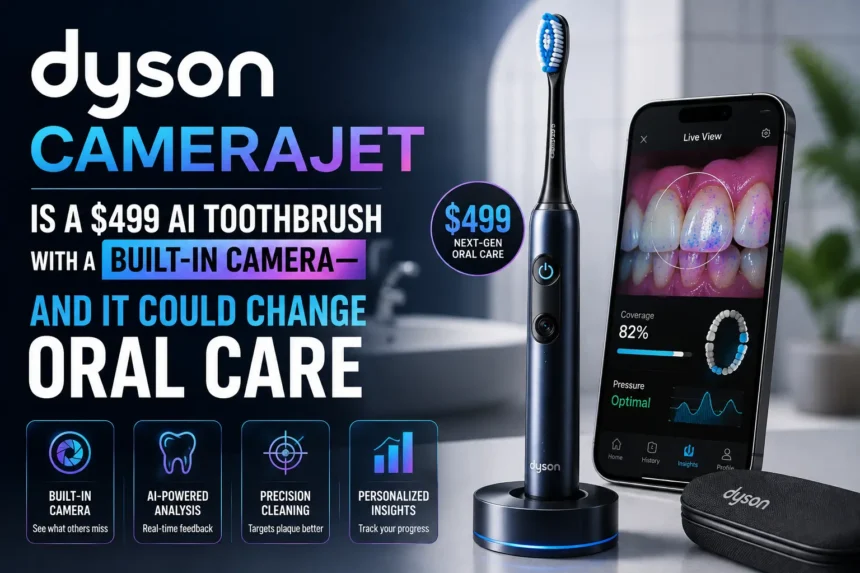
The company has unveiled the Dyson CameraJet, a premium electric toothbrush priced at $499, featuring an unusual combination of artificial intelligence, a built-in camera, precision water jets and app connectivity. Rather than simply improving how people brush their teeth, Dyson is trying to rethink the entire routine by bringing interdental cleaning directly into the brushing process.
The move comes as oral care increasingly begins to resemble the beauty industry. Toothpaste, mouthwash, floss and electric toothbrushes are no longer being marketed purely around cavities and plaque. A growing group of brands is positioning oral care as part of a broader wellness and beauty routine, with greater attention to ingredients, design, sensory experiences and technology.
Dyson’s new toothbrush sits directly at the intersection of those trends.
Dyson CameraJet Puts a Camera Inside the Toothbrush
The most eye-catching feature of the CameraJet is its tiny integrated camera.
Dyson says the camera is designed to focus on the spaces between teeth, areas where plaque can accumulate and which many people struggle to clean effectively. The toothbrush combines that visual technology with a precision water jet intended to target those hard-to-reach gaps.
More Read
The device also connects to Wi-Fi at 2.4GHz and works with the MyDyson app, allowing users to see what the toothbrush’s camera is capturing while they brush.
That makes the CameraJet considerably different from conventional smart toothbrushes.
Smart toothbrushes from established oral-care companies have already been able to monitor factors such as brushing duration, pressure and coverage. Dyson’s approach is more visual: instead of relying only on sensors and brushing patterns, the company wants users to actually see the areas they are cleaning.
Dyson says the CameraJet is the first toothbrush to combine an integrated camera with a precision jet in this way.
The $499 Price Makes It a Luxury Oral-Care Product
At $499, the Dyson CameraJet is not trying to compete with ordinary electric toothbrushes.
It is positioned as a premium technology product, much like Dyson’s hair dryers, air purifiers and other high-end appliances. The price also places it firmly within the emerging luxury oral-care movement, where brands are attempting to turn everyday dental routines into something more sophisticated and desirable.
For most consumers, brushing teeth remains a simple two-minute task. Dyson’s proposition is that the routine can become more precise, connected and engaging if technology is used to address the steps people frequently skip.
The company says its research found that many people spend considerably less than the recommended two minutes brushing, while flossing is another routine that consumers often avoid.
That behavioral gap is central to Dyson’s strategy.
Instead of asking people to remember another separate step, such as flossing after brushing, the CameraJet attempts to integrate interdental cleaning into the same device.
Dyson Wants to Make Flossing Less of a Chore
Flossing has remained one of the least popular parts of everyday oral care.
People know they should do it, but consistency can be difficult. Dyson’s solution is essentially to remove some of the friction by bringing targeted interdental cleaning into the toothbrush itself.
The CameraJet uses precision water jets to reach between teeth, while the camera provides visual feedback. The idea is to encourage users to move more methodically across the mouth rather than quickly brushing the visible surfaces of their teeth.
That could be an important distinction.
Traditional electric toothbrushes primarily focus on improving the brushing process. Dyson is attempting to turn the toothbrush into a broader oral-care platform.
The company has also developed a proprietary non-foaming toothpaste and mouth rinse for the CameraJet. These products are designed to improve visibility for the extremely small camera, which Dyson says measures approximately one millimeter square.
In other words, the ecosystem is being designed around the technology rather than simply adding a camera to an existing toothbrush.
Oral Care Is Getting a Beauty Industry Makeover
Dyson’s launch also reflects a much bigger change taking place across the oral-care market.
For years, toothpaste and mouthwash were largely sold using clinical language: cavities, plaque, gingivitis, freshness and protection. Packaging was functional, and most products were designed to disappear into the bathroom cabinet.
That approach is changing.
Newer oral-care companies are borrowing heavily from skincare and beauty. Products increasingly emphasize attractive packaging, sophisticated ingredients, pleasant textures and distinctive flavors.
Some brands are focusing on the oral microbiome, while others are experimenting with ingredients such as nano-hydroxyapatite and hyaluronic acid. Mouthwash is being positioned more like a skincare serum, and breath sprays are increasingly designed as portable lifestyle accessories rather than simple pharmacy products.
Even the names and visual identities of emerging brands are beginning to resemble fragrance, fashion and skincare labels.
This shift is important because oral care is already a huge global market. The opportunity is no longer simply selling consumers another tube of toothpaste. Brands are trying to persuade people to spend more money on a routine they perform every day.
Technology Is Bringing Oral Care Closer to Beauty Tech
The CameraJet also follows a familiar pattern from the beauty-device market.
Over the past decade, products such as LED masks, facial-cleansing devices and microcurrent tools have transformed technology-heavy beauty treatments into consumer products for home use.
Dyson appears to be applying a similar philosophy to dental care.
The CameraJet combines hardware, software and data in a way that makes a traditionally clinical product feel more like a connected beauty device.
Its camera provides visual information. Its water jet delivers targeted cleaning. The MyDyson app creates the digital interface. And the premium industrial design gives the product the kind of visual identity associated with Dyson’s other technology products.
That combination could help oral care move beyond the traditional healthcare aisle.
Premium Oral Care Is Moving Into Fashion and Lifestyle Retail
The changing perception of oral care is also reflected in where these products are being sold.
Premium oral-care products are increasingly appearing in upscale grocery stores, lifestyle retailers and fashion-oriented shopping platforms rather than only pharmacies and supermarkets.
Brands such as Selahatin have pushed oral care into luxury and fashion territory, while other emerging companies are building products designed to be displayed rather than hidden away.
Retailers are noticing the trend as consumers show interest in areas including tongue scraping, oil pulling, specialized mouth rinses, electric flossers and ingredient-focused toothpaste.
The logic is straightforward: if consumers are willing to spend heavily on skincare, haircare and wellness products, there is potentially a similar opportunity to upgrade another twice-daily habit.
Dyson’s CameraJet takes that concept a step further by making technology the centerpiece.
What Makes the Dyson CameraJet Different?
The CameraJet’s appeal ultimately comes down to its combination of features rather than any single specification.
It offers:
The bigger question, however, is whether consumers will consider those features valuable enough to justify the price.
A $499 toothbrush is competing not only against other smart toothbrushes but also against the consumer’s existing habits. People can buy conventional electric toothbrushes for a fraction of the cost, while floss, water flossers and other oral-care products are readily available separately.
Dyson therefore needs to demonstrate that integrating these technologies genuinely makes oral care easier, more effective or more enjoyable.
Dyson Is Betting on a More Personalized Oral-Care Future
The CameraJet represents an interesting shift in how technology companies view personal-care products.
Instead of simply making an existing appliance more powerful, Dyson is trying to change consumer behavior. The company believes that giving people better visibility into their brushing routine—and incorporating interdental cleaning into it—could encourage more thorough oral care.
Whether that vision becomes mainstream remains to be seen.
But the launch is significant regardless of how successful the product becomes. Dyson has entered a category that has historically been dominated by clinical messaging and relatively standardized products, at a time when consumers are increasingly treating oral health as part of their broader beauty and wellness routines.
The $499 Dyson CameraJet may therefore be more than an expensive toothbrush. It is a statement about where oral care could be heading: connected, personalized, design-focused and increasingly influenced by the same premium beauty culture that has transformed skincare and haircare.
And if Dyson’s strategy works, the humble toothbrush may soon become another everyday device that consumers expect to be as smart—and as desirable—as the technology around it.