

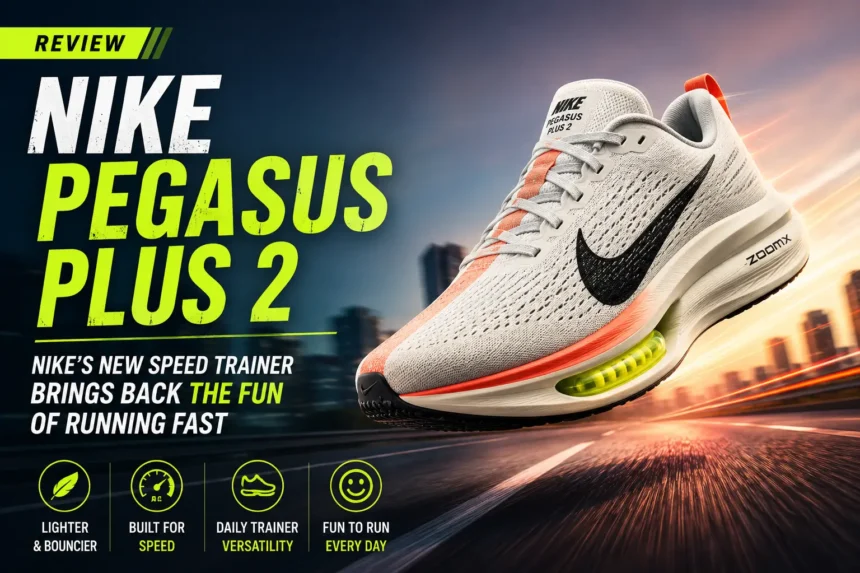
Nike is taking another serious swing at the idea of a running shoe that can do almost everything. The new Nike Pegasus Plus 2 is designed for runners who want the comfort of a daily trainer but also expect enough responsiveness for tempo sessions, faster miles and spontaneous bursts of speed.
That positioning makes the Pegasus Plus 2 particularly interesting because it sits in a part of the running-shoe market that has become increasingly competitive. Modern trainers are getting taller, softer and more technologically advanced, while lightweight racing shoes continue to become more aggressive. In between those two extremes, many runners are still looking for a shoe that feels genuinely enjoyable at different speeds.
The Pegasus Plus 2 appears to be Nike’s answer.
The new model builds on the Pegasus Plus formula with a redesigned forefoot Air unit, a more accommodating upper and the familiar combination of ZoomX foam and a performance-oriented geometry. Nike says the new Air system delivers an 18% improvement in energy return compared with the previous model.
The result is a running shoe that aims to feel comfortable when the pace is easy but becomes increasingly lively when the runner starts pushing.
Nike Pegasus Plus 2: What’s New?
The most significant change is underneath the forefoot.
More Read

Unlike the previous Pegasus Plus, the new Pegasus Plus 2 introduces an exposed, curved Air unit in the forefoot. Nike says the design was influenced by technology used in the Pegasus 42, although the implementation here is different because the Air unit is limited to the front portion of the shoe.
The curved design is intended to make the transition from heel landing to toe-off smoother. Air units are relatively rigid compared with foam, so simply placing an Air structure next to soft midsole foam can sometimes create a noticeable change in the ride.
Nike’s curved approach is designed to make that transition feel more natural.
The exposed construction is also important. Rather than completely surrounding the Air unit with foam, Nike allows more room for it to deform under load. The company says this helps the Air unit deliver a more pronounced response while maintaining cushioning.
According to Nike, the Pegasus Plus 2 produces 18% more energy return than the previous generation.
That number sounds impressive, but the more important question for runners is how that additional response translates onto the road. Based on early testing, the answer depends heavily on how fast you run and where you land.
At slower paces, the shoe feels cushioned and relatively relaxed. Increase the pace and move toward the forefoot, however, and the Pegasus Plus 2 becomes noticeably more energetic.
That makes it an intriguing option for runners who don’t want a separate shoe for every workout.
A Roomier Fit Could Be One of the Biggest Improvements
Nike has also changed the upper and fit.
The Pegasus Plus 2 uses an updated last shape that provides more room around the toes while maintaining a secure fit through the heel and midfoot. This is an important change because previous Nike running shoes have sometimes been criticized for feeling restrictive through the forefoot.
The new design attempts to solve that without turning the shoe into a loose, comfort-first trainer.
The heel remains snug, while the midfoot provides the lockdown necessary for faster running. At the same time, the big toe and little toe have more room to spread naturally.
For runners who have avoided certain Nike models because of their narrow-feeling forefoot, the Pegasus Plus 2 could therefore be considerably more appealing.
The balance is particularly important in a speed trainer. A loose upper can make a shoe feel inefficient during faster running, but an overly tight toe box can quickly become uncomfortable during longer sessions.
Nike appears to have targeted the middle ground.
ZoomX Foam Remains at the Center of the Ride
The Pegasus Plus 2 continues to use PEBA-based ZoomX foam, one of Nike’s most recognizable performance foams.
ZoomX is known for its low weight and high energy return, and its presence gives the Pegasus Plus 2 a different personality from the standard Pegasus models.
Instead of feeling like a traditional mileage trainer, the shoe has a more energetic character.
The heel provides a softer landing, making the shoe comfortable enough for easy running. When the pace increases, the combination of ZoomX foam and the forefoot Air unit starts to become more noticeable.
This dual personality is arguably the biggest selling point of the Pegasus Plus 2.
Many runners have separate shoes for easy mileage and workouts. A heavily cushioned trainer can be excellent for recovery days but feel cumbersome during faster sessions, while a racing shoe can be exciting at speed but unnecessary for a casual five-mile run.
The Pegasus Plus 2 attempts to occupy the space between them.
How Does the Nike Pegasus Plus 2 Feel on the Run?
The first thing runners are likely to notice is that the shoe doesn’t immediately feel like an all-out racing shoe.
That is intentional.
At easy speeds, the ZoomX foam provides a relatively soft landing, particularly when the runner loads the heel. The cushioning makes the Pegasus Plus 2 suitable for relaxed morning runs and everyday mileage.
But the personality changes as the pace increases.
When runners move toward a forefoot strike, the Air unit becomes more apparent. The result is a sharper and more responsive toe-off that encourages faster running.
This is where the Pegasus Plus 2 makes its strongest argument.
It doesn’t demand that every run become a workout. Instead, it seems happy to let the runner decide how much performance is required.
Running easy? The ZoomX foam provides comfort.
Running faster? The forefoot Air unit becomes more noticeable.
Running a tempo session? The shoe has enough responsiveness to make the workout enjoyable without feeling like an aggressive racing flat.
That versatility is exactly what made the original Pegasus Turbo so memorable for many runners.
But There Is a Weight Trade-Off
The Pegasus Plus 2 isn’t the lightest performance trainer available.
A men’s size 10 is listed around the 9.3-ounce range in the supplied specifications, while larger sizes naturally weigh more. That places it in a reasonable range for a daily trainer, but runners moving directly from lightweight racing shoes may notice the difference.
This is an important consideration.
A dedicated race shoe is designed around maximum efficiency at high speeds. Every gram matters, and the geometry is often built specifically to encourage rapid transitions.
The Pegasus Plus 2 takes a different approach.
It sacrifices some weight in exchange for cushioning, durability and everyday usability.
For most runners, that isn’t necessarily a problem. In fact, the additional weight may be barely noticeable during normal mileage.
But if your primary goal is setting a personal best in a 5K or 10K, a dedicated racing shoe will likely remain the more logical choice.
What Happens at Easy Paces?
One of the most interesting aspects of the Pegasus Plus 2 is its ability to handle slow running.
Performance-oriented shoes can sometimes feel awkward when they’re used outside their intended pace range. A stiff or highly aggressive shoe may feel fantastic during intervals but unnecessarily demanding during recovery runs.
The Pegasus Plus 2 takes a more relaxed approach.
When the runner lands toward the heel, the ZoomX foam compresses underneath the foot and provides a softer sensation. The ride becomes more comfortable when the pace is deliberately slowed.
That makes the shoe suitable for those days when the legs aren’t interested in running fast.
It also means runners can potentially use the Pegasus Plus 2 for a larger portion of their weekly mileage instead of reserving it exclusively for workouts.
Tempo Runs Are Where It Gets Interesting
The Pegasus Plus 2 really begins to make sense during tempo efforts.
At a faster pace, the forefoot Air unit becomes more noticeable and the shoe feels considerably more responsive than it does during slow running.
That doesn’t mean the shoe suddenly transforms into a Vaporfly-style racer. It doesn’t have the same aggressive race-day setup, and it isn’t designed to replace Nike’s carbon-plated racing shoes.
Instead, the Pegasus Plus 2 provides a more accessible version of that fast-running sensation.
For a four-mile tempo, progression run or moderately fast interval session, that can be exactly what many recreational and competitive runners want.
You get enough cushioning to avoid feeling beaten up while still receiving a clear signal from the shoe that it’s ready to accelerate.
The Forefoot Feel Won’t Be Perfect for Everyone
The biggest potential weakness is also connected to the shoe’s new technology.
The forefoot can feel noticeably firmer and more structured than the heel. Runners who prefer a uniformly soft ride may not immediately love that contrast.
The difference between soft ZoomX foam and the relatively rigid Air structure can become more apparent at moderate paces, particularly when the runner lands somewhere between the heel and forefoot.
That can create a sensation that the shoe has two slightly different personalities.
At easy speeds, the heel feels soft.
At fast speeds, the forefoot feels lively.
In the middle, the transition may not feel quite as seamless for every runner.
This isn’t necessarily a design flaw. It is more a consequence of trying to combine two different sensations in one shoe.
Runners who enjoy a firm, responsive toe-off may appreciate it. Those who prefer a consistently plush ride may want something softer.
Nike Pegasus Plus 2 Specifications
The Pegasus Plus 2 is positioned as a performance-oriented daily trainer rather than a dedicated race shoe.
| Specification | Nike Pegasus Plus 2 |
|---|---|
| Price | $170 |
| Cushioning | PEBA-based ZoomX foam + forefoot Air unit |
| Heel Height | 38 mm |
| Forefoot Height | 28 mm |
| Drop | 10 mm |
| Men’s Weight | Approx. 9.3 oz, size 10 |
| Upper | Updated performance-oriented design |
| Intended Use | Daily runs, tempo runs and faster training |
Specifications can vary by size and market.
Nike Pegasus Plus 2 vs. Regular Pegasus
The Pegasus Plus 2 and the standard Pegasus models target slightly different runners.
The regular Pegasus is designed to be a dependable everyday running shoe. It focuses heavily on versatility, comfort and durability.
The Pegasus Plus 2 moves further toward performance.
Its ZoomX-based midsole and forefoot Air system are designed to make faster running more engaging. That makes the Plus 2 particularly attractive to runners who regularly include tempo workouts, progression runs or intervals in their training.
If most of your running is easy-paced mileage, the standard Pegasus may make more sense.
If you want a daily trainer that can become a speed shoe when required, the Pegasus Plus 2 is the more interesting option.
Is the Pegasus Plus 2 the New Pegasus Turbo?
That comparison is almost unavoidable.
The original Pegasus Turbo developed a cult following because it offered something unusual: the performance character of Nike’s racing technology in a shoe that could still be used for everyday training.
The Pegasus Plus concept clearly occupies similar territory.
However, runners shouldn’t expect the Pegasus Plus 2 to be an exact recreation of the Turbo.
Running-shoe technology has changed significantly since the original Turbo. Today’s trainers use different foams, geometries and cushioning systems, while modern racing shoes have become considerably more sophisticated.
Instead of reproducing the Turbo, Nike is taking the underlying idea and updating it.
The goal is the same: make fast running more accessible without making every run feel like race preparation.
Who Should Buy the Nike Pegasus Plus 2?
The Pegasus Plus 2 makes the most sense for runners who want one shoe that can cover several different types of training.
It’s especially appealing if your weekly schedule includes a combination of easy runs, steady efforts and tempo workouts.
It’s also worth considering if you don’t enjoy the extremely tall, soft and maximalist feeling of some modern running shoes.
The Pegasus Plus 2 provides cushioning without completely disconnecting the runner from the road.
Runners with wider forefeet may also appreciate the updated fit compared with narrower-fitting Nike designs.
However, there are reasons to look elsewhere.
If maximum softness is your priority, a more cushioned daily trainer may be better.
If maximum racing performance is your priority, a dedicated carbon-plated racing shoe will be more appropriate.
And if you strongly prefer a consistent, soft forefoot, the Pegasus Plus 2’s Air-assisted response may take some getting used to.
Nike Pegasus Plus 2 Pros and Cons
Pros
Cons
Final Verdict: Is the Nike Pegasus Plus 2 Worth Buying?
The Nike Pegasus Plus 2 is an interesting evolution of Nike’s speed-focused Pegasus concept.
Its biggest strength isn’t that it is the fastest running shoe Nike makes. It isn’t.
Instead, its appeal comes from how easily it moves between different types of running.
The ZoomX foam provides a comfortable foundation for easy miles, while the new curved forefoot Air unit adds a more energetic sensation when the pace increases. The roomier forefoot is another welcome improvement, particularly for runners who have previously found some Nike shoes restrictive.
There are compromises. The shoe isn’t ultralight, and the contrast between the soft rearfoot and firmer, more responsive forefoot won’t suit every runner.
But that may be the price of its versatility.
For runners who want a single pair of shoes that can handle neighborhood mileage during the week and a faster workout when the mood strikes, the Pegasus Plus 2 is a compelling proposition.
It also succeeds at something that isn’t easy to measure on a specification sheet: it makes the idea of running fast feel fun again.
At a listed price of $170, the Pegasus Plus 2 sits below many premium racing shoes while offering a more performance-oriented experience than a conventional daily trainer. That makes it particularly attractive for runners who don’t want to spend $250 or more every time they want a faster ride.
The Time City Rating: 4.3/5
Best for: Daily training, tempo runs, progression runs and runners who want a versatile speed trainer.
Not ideal for: Maximum-cushioning fans, dedicated marathon racers or runners who prefer an extremely soft forefoot.
The Pegasus Plus 2 doesn’t bring back the Pegasus Turbo exactly. Instead, Nike has created something that makes sense for today’s running landscape—a modern, versatile trainer that can cruise comfortably and still encourage you to pick up the pace when the road ahead looks inviting.
Frequently Asked Questions
Is the Nike Pegasus Plus 2 good for everyday running?
Yes. The ZoomX cushioning gives the shoe enough comfort for everyday mileage, while the forefoot Air unit provides additional responsiveness for faster efforts.
Is the Pegasus Plus 2 good for tempo runs?
Yes. Tempo running is one of the areas where the shoe’s responsive forefoot becomes particularly useful. It offers a faster feel without the aggressive character of a dedicated racing shoe.
Does the Pegasus Plus 2 have a carbon plate?
No. The shoe uses ZoomX foam and a forefoot Air unit rather than a carbon-fiber plate. This gives it a more flexible and less aggressive personality than Nike’s top racing models.
Is the Pegasus Plus 2 suitable for beginners?
It can be. Beginners who want a versatile running shoe may appreciate its cushioning and performance, although a conventional daily trainer could be a simpler choice for someone who isn’t doing faster workouts.
How much does the Nike Pegasus Plus 2 cost?
The listed price in the supplied launch information is $170. Retail pricing and availability can vary by country, size and colorway.
Is the Pegasus Plus 2 the same as the Pegasus Turbo?
No. The Pegasus Plus 2 follows a similar philosophy but uses a newer combination of ZoomX foam and forefoot Air technology. It should be viewed as a modern successor in spirit rather than a direct reissue of the Turbo.
Who should consider buying the Pegasus Plus 2?
Runners who want one shoe for easy mileage and faster workouts are the best match. It is particularly appealing to runners who don’t want an extremely soft, tall or heavily structured racing shoe for every workout.
Where to Buy
The Nike Pegasus Plus 2 is positioned as a premium daily trainer and is expected to be available through Nike and selected running-shoe retailers. Before purchasing, runners should check the latest size availability, color options and regional pricing.
For the latest Nike running-shoe launches, reviews and technology updates, keep following The Time City.